
If you are looking for strategic planning concepts to include in your management toolbox, you came to the right place.
This strategic planning guide was initially developed as a reviewer for a comprehensive exam of an MBA program, but MSMEs can use the concepts in planning the strategy for businesses.
Strategic Planning Table of Contents
Management
Strategy
Porter’s Five Forces Theory of Industry Structure
Generic Strategies
Strategy As Part Of An Organization: The Seven S Model
The Value Chain and Integration
The Ansoff Matrix (Expansion Strategy)
Competitive Tactics: Signaling
Portfolio Strategies
Strategy Implementation
The Roles of the CEO
Organizational structure and controls
Building Organizational Capabilities
Strategy and Organizational Planning
Leadership, Ideology and Organizational Culture
Lecture Notes on Organizational Culture
Politics, Power, and Influence in organization
Power and Politics
[Bonus]: Managing your Boss
International Expansion
Management
The foundation of strategic planning is always management. You need to understand management first before you can develop correct strategies for your business.
Definitions of Management
- Management is the efficient allocation of resources to achieve a given set of objectives. This version puts the weight on efficiency: the same result from fewer resources is better management.
- Management is the supervising or directing of an enterprise. This is the narrowest definition, and the one most owners default to without realising it.
- Management is the process of leading and directing all or part of an organization through the deployment of resources, whether human, financial, material, intellectual or intangible. Notice how wide that list runs. Your reputation and your staff’s know-how are resources you manage just as deliberately as your cash.
- Management is the activity of getting things done with the aid of people and other resources. The phrase worth sitting with is “with the aid of people” — past a certain size, nothing you achieve is achieved alone.
- Management is the effective utilization and coordination of resources such as capital, plant, materials and labor to achieve defined objectives with maximum efficiency. This one adds coordination, which is the part that breaks first when a business grows.
The common thread across all of them: management is what turns resources into results on purpose. If results are happening but nobody can explain why, that is luck, and luck is not something you can repeat on demand.
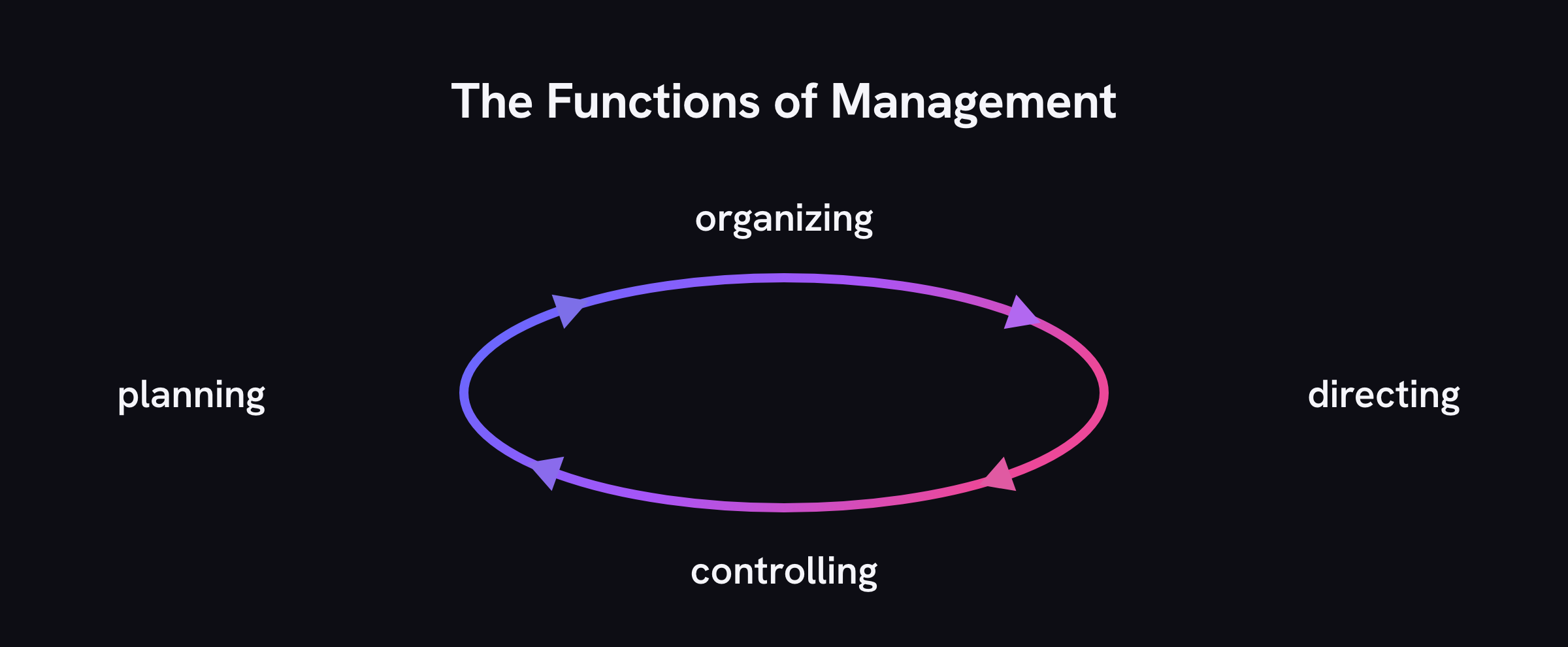
Functions of Management
Planning
Planning is the entrepreneurial function, the part of managing that sits closest to actually starting something. It means identifying a deliberate end: a specific result you have chosen, not a general wish to grow. At the top level it also requires an honest assessment of what your stakeholders need, because a plan that serves only the owner tends to get quietly resisted by everyone expected to deliver it.
Organizing
Organizing begins with an assessment of the resources you actually have, not the ones you wish you had. It then extends to identifying your other strategic assets, and those are usually the ones that never appear on a balance sheet: a location a competitor cannot match, a supplier who takes your call at 6am, a permit that took three years to secure. Owners routinely underrate these, precisely because they did not pay cash for them.
Directing
Directing is the work of leading, guiding, motivating and actuating the efforts of your employees — turning a plan on paper into people doing something different on Monday morning. It is worth being precise about two words that get used interchangeably: management has to do with power by position, whereas leadership involves power by influence. Your title makes people comply. Only influence makes them care, and the distance between complying and caring is most of your quality problem.
Controlling
Controlling means establishing sound feedback mechanisms, so you find out what is actually happening while you can still do something about it. Its purpose is to ensure plans come to fruition rather than quietly dying in the gap between the decision and the doing. And when results do not match the plan, controlling is what determines the steps to adapt. That last part is where most small businesses stop: they measure, they notice the variance, and then nothing changes. A control system that produces reports but never produces a decision is just expensive record-keeping.
Strategy
Strategy is a way to achieve, and hopefully sustain, a competitive advantage. The second half of that sentence carries the weight. Plenty of businesses find an advantage; far fewer keep one, because anything that visibly works gets copied by whoever is watching.
Put more formally, strategy is top management’s plan to attain outcomes that are consistent with the mission and goals of the organization. Consistency is the test worth applying to your own decisions. If an opportunity would make money but pull you away from what your business is actually for, it is not a strategic opportunity. It is a distraction with good margins.
Strategic Management
Strategic management is broader than strategy itself. Strategy is the choice; strategic management is the whole job of making that choice and then living with it. It is top-management centric, which is a polite way of saying that in a smaller business this is your job and cannot be handed to someone who does not control the resources.
In practice it means understanding your environmental situation first, then formulating strategies, then implementing them. The order matters, and it is the order most often skipped. Owners tend to jump straight to implementing something they watched a competitor do, without first asking whether their situation is the same one.
Strategic Management Process
The process runs in five stages, and they are sequential for a reason: each one is only as good as the stage before it.
- External Analysis — reading the situation outside your walls: customers, competitors, suppliers, regulation, and what is changing in each of them.
- Internal Analysis — an honest inventory of what you can actually do, including the capabilities you have and the ones you only believe you have.
- Strategy Formulation — deciding where to compete and how, which necessarily means deciding what you will not do.
- Strategy Execution — turning that choice into budgets, roles and changed behavior. This is where most strategies die.
- Strategic Control — checking whether it is working and adjusting, instead of discovering a year later that the plan stopped matching reality in month three.
5 Ps of Strategy
Henry Mintzberg of McGill University set out the 5 Ps in 1987, arguing that strategy is not one thing but five different things people mean when they use the word.
Strategy as a Plan
Strategy as a plan is the most familiar sense of the word: following what is on paper. Whether or not it ever gets formally documented, a plan is intentional and premeditated — you decided it in advance rather than discovering it afterwards. This is the version that produces strategic planning documents, and it is what most people mean when they say a business has no strategy.
Strategy as a Pattern
Strategy as a pattern is simply doing what works. It is born from previous successes that harden into habitual behavior, which means the strategy is visible in what a company repeatedly does rather than in anything it wrote down. Jollibee acquires Greenwich, then Chowking, then Red Ribbon — nobody needs to read a document to guess what comes next. Your own business has a pattern too, and the useful question is whether you chose it or simply drifted into it.
Strategy as a Position
Strategy as a position is about being true to your identity: deciding what you want to be known for, then staying consistent with it. In practice it shows up as product positioning strategies and price/value positions — the deliberate choice to occupy a particular point in the market instead of chasing every customer who walks past. Consistency is the whole game here. A business that is premium on Monday and discounting on Friday has not positioned itself, it has confused everybody.
Strategy as a Perspective
Strategy as a perspective is being true to what you believe in. It describes firms operating from a genuinely different world-view than their competitors, and that difference drives choices the competition would not make. It runs in both directions: at one end idealism, a company that will not take certain business at any price; at the other, a willingness to stretch the limits of the law. The uncomfortable part is that beliefs and attitudes cannot easily be changed, so if your people do not already share the perspective, you cannot simply announce it at a meeting and expect it to take.
Strategy as a Ploy
Strategy as a ploy is disrupting the playing field: doing something apparently unthinkable in order to confuse a competitor, divert their attention, or capture the market’s. A ploy is a maneuver rather than a long-term position — its whole purpose is to provoke a reaction. Smaller businesses can use this more freely than large ones, because a competitor with more to lose is usually slower to respond to something that looks irrational.
Levels Of Strategy
There are three levels of strategy to be considered, and they nest inside one another — from the daily work, up through how you fight your competitors, to which businesses you should be in at all.
Functional Strategy (The value activities engaged in)
Functional strategies are those operational methods and “value-adding” activities that management chooses for its business.
Business Strategy (How to fight the competition, tactics)
Business strategies are those battle plans used to fight the competition in the industry that a company currently participates in.
Corporate Strategy (What businesses should I be in?)
The corporate strategy looks at the whole gamut of business opportunities.
Theoretical Perspectives
The distinction between deliberate and emergent strategy is also Mintzberg’s. A deliberate strategy is the one you set out to follow; an emergent strategy is the pattern that actually forms out of the decisions you make along the way. Examples of Deliberate vs. Emergent Strategies:
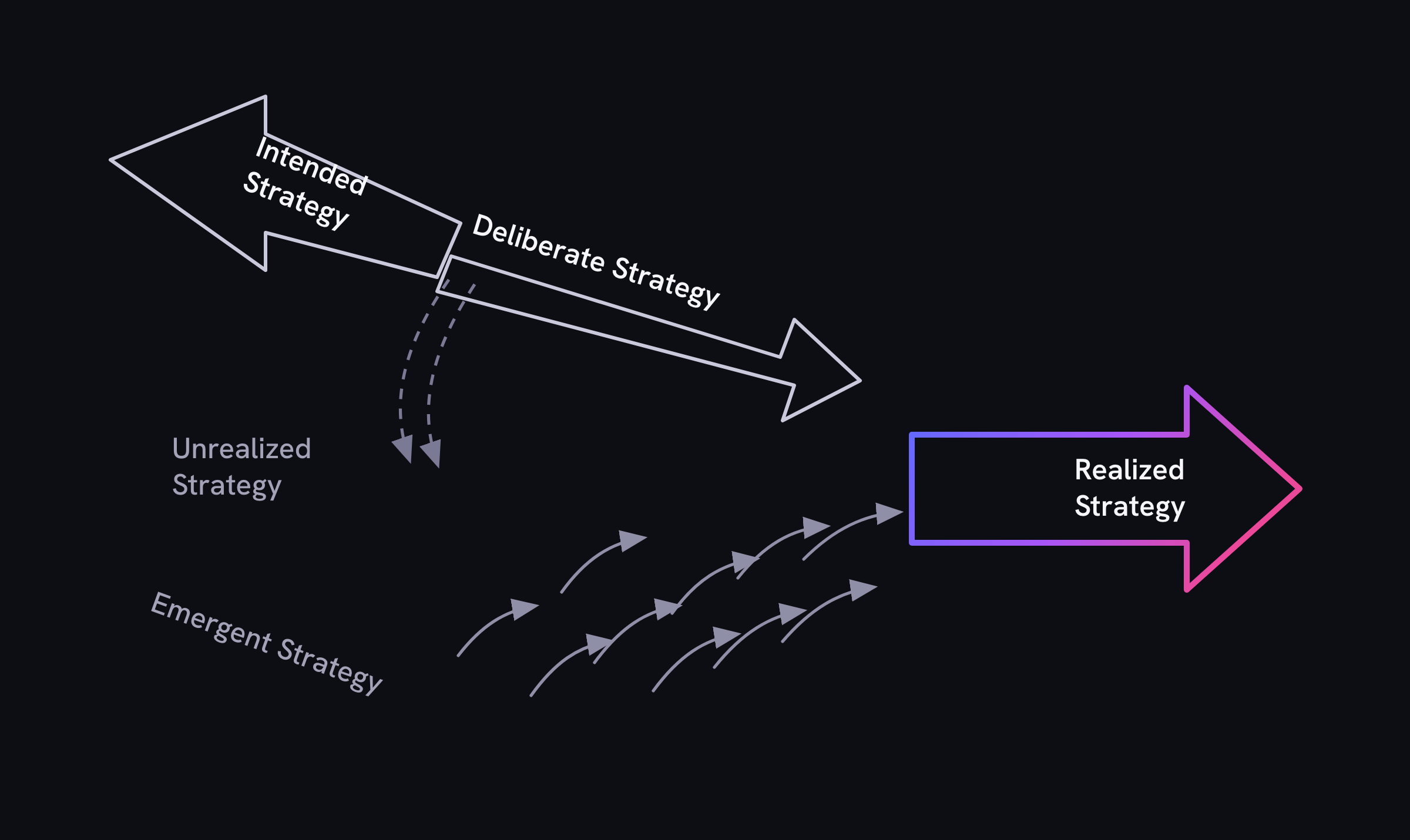
- Globe Telecom. In the late 1990s it intended to compete on the quality of its digital services. It ended up competing on text messaging instead.
- Pepsi Cola. In the US it spent decades trying to compete on price, and ended up winning through segmentation.
Neither company failed. Both ended up somewhere other than where the plan pointed, and in each case the pattern that formed was the real strategy. Worth asking of your own business: if someone mapped what you have actually done over the last three years, would it match the plan you would describe out loud?
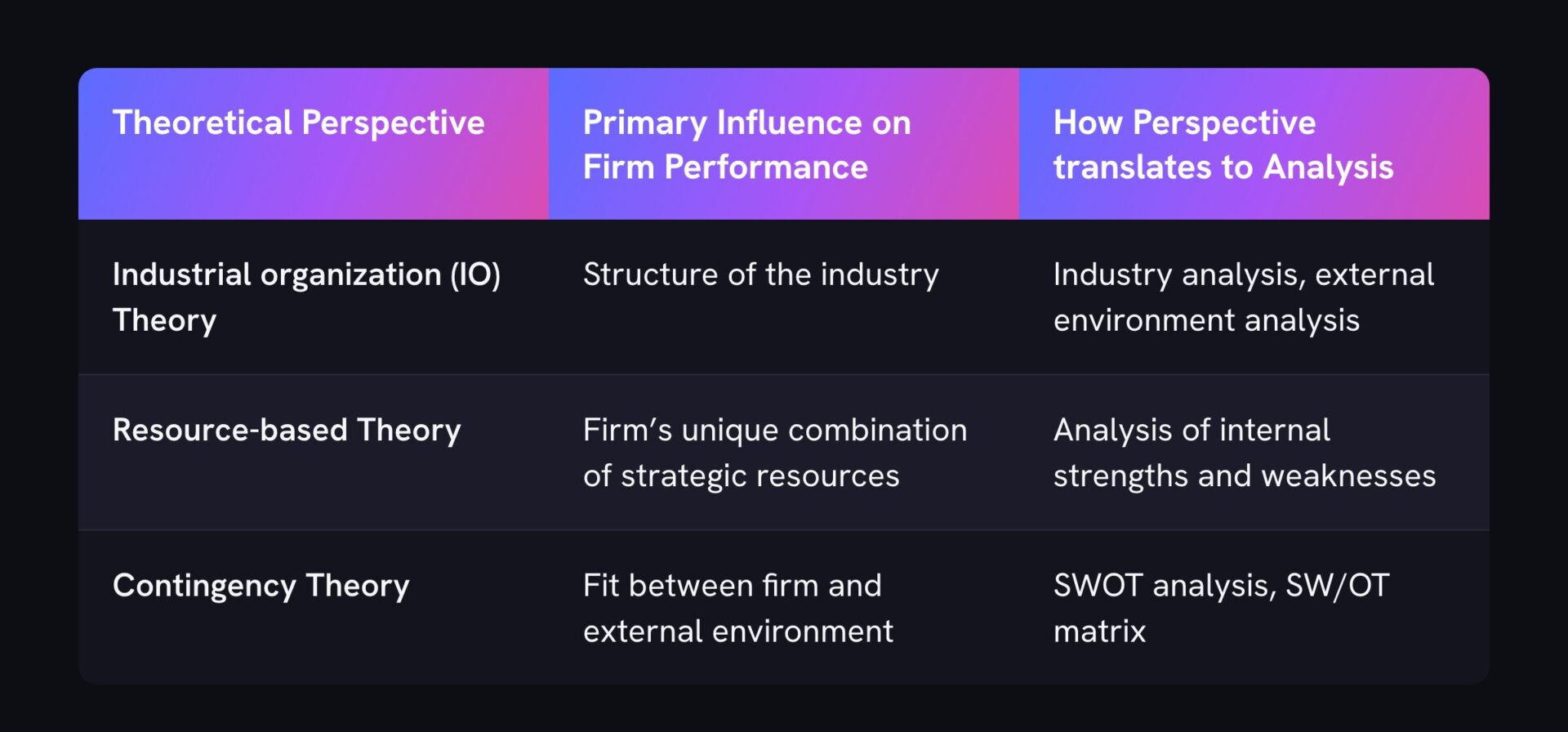
Three theoretical perspectives compete to explain why some firms outperform others. They disagree about where performance actually comes from, and the disagreement is worth understanding, because each one sends you looking for an advantage in a different place.
I/O Theory
The Industrial Organization model of above-average returns looks outward. It assumes the external environment is what most affects firm performance: the structure of the industry you happen to be in, economies of scale, barriers to entry, and how much rivalry the market sustains. It is grounded in economic theory, and its implication is blunt. Choose your industry carefully, because the industry does much of the work for you or much of the damage to you.
For a smaller business that reads as an uncomfortable truth: some markets are simply kinder than others, and effort will not rescue you from one that is structurally brutal. If every competitor around you is discounting to survive, that is the industry talking, not your management.
Resource-Based Theory
Resource-based theory looks inward instead. Performance is a function of the resources a firm holds and its ability to actually use them, and the second half of that sentence carries as much weight as the first. Plenty of businesses own advantages they never deploy. A unique combination of resources and the strategies for using them adds up to a distinctive competence, and a distinctive competence is what becomes a competitive advantage.
This is the more useful lens for most MSMEs, for a practical reason: you usually cannot choose a gentler industry, but you can be deliberate about what you are uniquely good at and make sure you are actually charging for it.
Contingency Theory (Institutional View)
Contingency theory refuses to choose between the other two. The firms that best fit their environment become the most profitable ones, which makes organizational performance a function of both environmental forces and the firm’s own strategic actions. Effective firms therefore work at the match, seeking out the environments where their particular resources are worth the most.
That reframes the question worth asking about your own business. Not “am I good at this” and not “is this a good market”, but “is this the market where what I am good at is worth the most money”. Those are three different questions and only the third one pays.
Strategic Thinking vs Strategic Planning
| Strategic Thinking | Strategic Planning | |
| Vision of the Future | Only the shape of the future can be predicted. | A future that is predictable and specifiable in detail. |
| Strategic Formulation and Implementation | Formulation and implementation are interactive rather than sequential and discrete. | The roles of formulation and implementation can be neatly divided. |
| Managerial Role in Strategy Making | Lower-level managers have a voice in strategy-making, as well as greater latitude to respond opportunistically to developing conditions. | Senior executives obtain the needed information from lower-level managers, and then use it to create a plan which is, in turn, disseminated to managers for implementation. |
| Control | Relies on self-reference – a sense of strategic intent and purpose embedded in the minds of managers throughout the organization that guides their choices on a daily basis in a process that is often difficult to measure and monitor from above. | Asserts control through measurement systems, assuming that organizations can measure and monitor important variables both accurately and quickly. |
| Managerial Role in Implementation | All managers understand the larger system, the connection between their roles and the functioning of that system, as well as the interdependence between the various roles that comprise the system. | Lower-level managers need only to know his or her own role well and can be expected to defend only his or her own turf. |
| Strategy Making | Sees strategy and change as inescapably linked and assumes that finding new strategic options and implementing them successfully is harder and more important than evaluating them. | The challenge of setting strategic direction is primarily analytic. |
| Process and Outcome | Sees the planning process itself as a critical value-adding element. | The focus is on the creation of the plan as the ultimate objective. |
Strategy as Learning
In 1990, Peter Senge, who had collaborated with Arie de Geus at Dutch Shell, popularized de Geus’ notion of the “learning organization“. The theory is that gathering and analyzing information is a necessary requirement for business success in the information age. To do this, Senge claimed that an organization would need to be structured such that:
- People can continuously expand their capacity to learn and be productive.
- New patterns of thinking are nurtured.
- Collective aspirations are encouraged.
- People are encouraged to see the “whole picture” together.
Senge identified five disciplines of a learning organization. They are:
Personal responsibility, self-reliance, and mastery
We accept that we are the masters of our own destiny. We make decisions and live with the consequences of them. When a problem needs to be fixed, or an opportunity exploited, we take the initiative to learn the required skills to get it done.
Mental models
We need to explore our personal mental models to understand the subtle effect they have on our behavior.
Shared vision
The vision of where we want to be in the future is discussed and communicated to all. It provides guidance and energy for the journey ahead.
Team learning
We learn together in teams. This involves a shift from “a spirit of advocacy to a spirit of inquiry”.
Systems thinking
We look at the whole rather than the parts. This is what Senge calls the “Fifth discipline”. It is the glue that integrates the other four into a coherent strategy.
an alternative approach to the “learning organization”
Geoffrey Moore (1991) and R. Frank and P. Cook also detected a shift in the nature of competition. Markets driven by technical standards or by “network effects” can give the dominant firm a near-monopoly. The same is true of networked industries in which interoperability requires compatibility between users.
Examples include Internet Explorer’s and Amazon’s early dominance of their respective industries. IE’s later decline shows that such dominance may be only temporary.
Moore showed how firms could attain this enviable position by using E.M. Rogers’ five stage adoption process and focusing on one group of customers at a time, using each group as a base for reaching the next group. The most difficult step is making the transition between introduction and mass acceptance. (See Crossing the Chasm).
If successful a firm can create a bandwagon effect in which the momentum builds and its product becomes a de-facto standard.
Strategic Planning Tool: Porter’s Five Forces Theory of Industry Structure
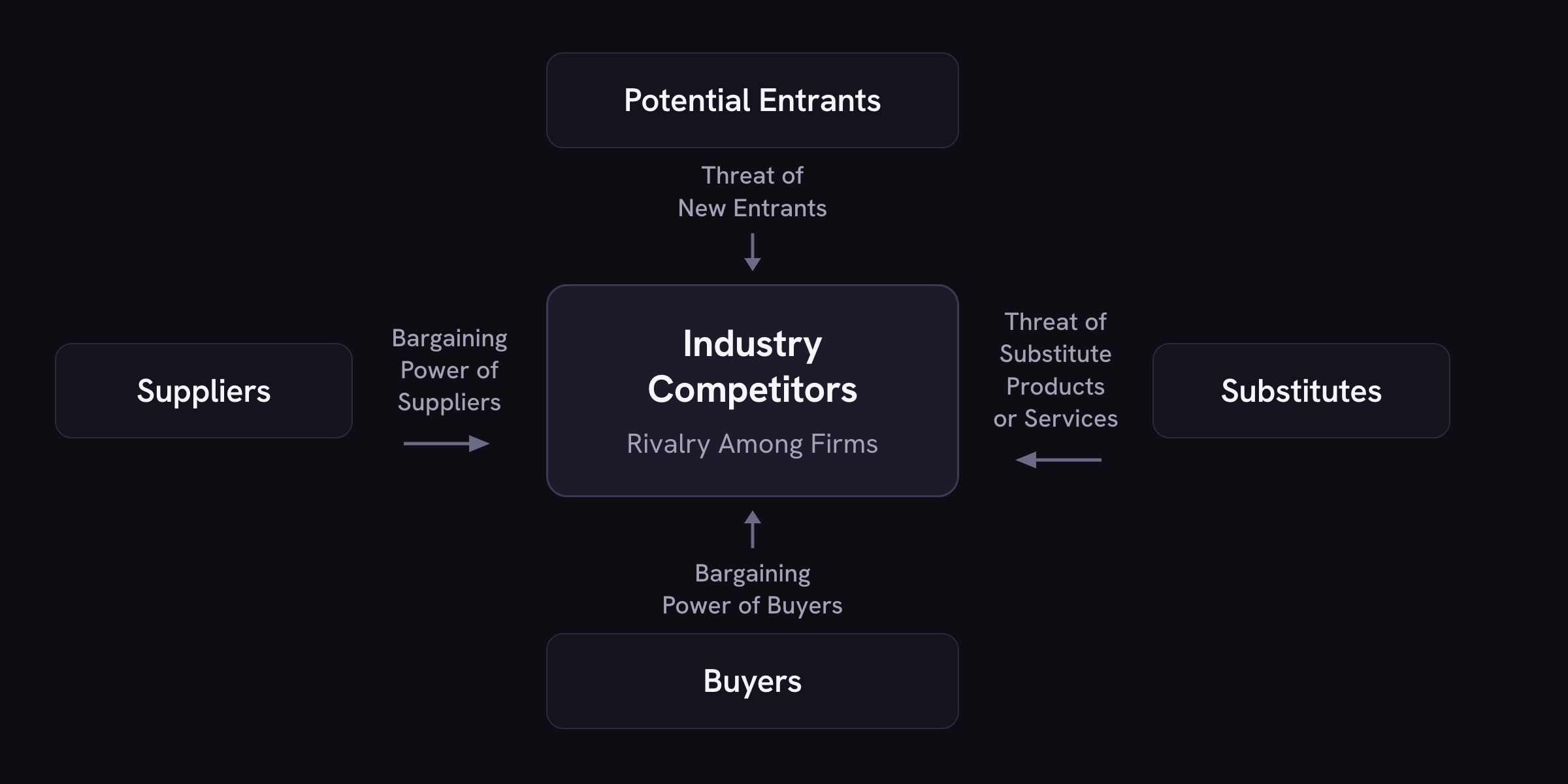
Michael Porter of Harvard has developed the Five Forces Theory of Industry Structure to help companies survive in a competitive environment.
Porter’s theories can be used to formulate survival strategies for your current business, as well as to evaluate the “attractiveness” of other industries for expansion.
Porter offers tools for investigating the five forces that determine the level of competition, and consequently, the level of profit in an industry. The five forces that drive industry competition are:
Threat of Substitutes
A substitute is not a competitor selling what you sell. It is a different way for the customer to solve the same problem, which is why substitutes are so often missed until they have already taken the market. Three things determine how badly one threatens you.
- Relative price performance — what the substitute delivers for the money, compared with what you deliver. A cheap substitute that does the job adequately is more dangerous than an expensive rival that does it well.
- Switching costs — what it costs the customer in money, time or disruption to move across. Where switching is easy, the threat is live every single day.
- Buyer propensity to substitute — how willing customers are to move at all. Some markets are habitual and slow to change; others move the moment something cheaper appears.
Threat of New Entrants
New entrants bring fresh capacity and ambition, and they usually buy their way in on price. What holds them back is entry barriers. It is worth being honest about which ones you actually have, because most small businesses have fewer than they think.
- Economies of scale — if incumbents produce far more cheaply at volume, a newcomer must either enter big or accept worse margins.
- Proprietary product differences — something in the product a newcomer cannot simply copy.
- Brand identity — the reason a customer chooses the known name at the same price.
- Switching costs — what your existing customers would have to give up to leave.
- Capital requirements — how much money it takes to open the doors at a credible scale.
- Access to distribution — whether a newcomer can even reach the customer. In Philippine retail this is frequently the real barrier, not capital.
- Absolute cost advantages — costs a newcomer cannot match at any volume, including a proprietary learning curve, privileged access to necessary inputs, and proprietary low-cost product design.
- Government policy — licences, permits and regulation that gate entry.
- Expected retaliation — what a newcomer believes you will do to them if they enter. A credible reputation for responding is itself a barrier.
Bargaining Power of Suppliers
Supplier power is the quiet one. It rarely announces itself; it just shows up as margin you never had. These are the conditions that hand suppliers the upper hand.
- Differentiation of inputs — whether what they supply is genuinely distinct or a commodity you could buy anywhere.
- Switching costs — what it would cost you, and them, to end the relationship.
- Presence of substitute inputs — whether an alternative material or service exists at all.
- Supplier concentration — how few of them there are. One supplier for a critical input is a strategic exposure, not a procurement detail.
- Importance of your volume to the supplier — whether losing you would hurt them. If you are a rounding error in their book, you have no leverage.
- Cost relative to total purchases in the industry — how much of the industry spend this input represents.
- Impact of inputs on cost or differentiation — whether the input drives your price or the thing customers value.
- Threat of forward integration — whether the supplier could simply start doing what you do, weighed against your own ability to integrate backward and start doing what they do.
Bargaining Power of Buyers
Buyer power splits into two separate questions that get muddled constantly: how much leverage the buyer has, and how sensitive they are to price. A buyer can have enormous leverage and barely use it, if price is not what they care about.
Bargaining leverage
- Buyer concentration versus firm concentration — how few buyers there are relative to sellers. A handful of large customers is a dangerous revenue base.
- Buyer volume — how much any single buyer takes.
- Buyer switching costs relative to yours — who is more trapped in the relationship.
- Buyer information — how much they know about your costs and your alternatives. Price transparency shifts power to the buyer.
- Ability to backward integrate — whether the buyer could credibly start doing it themselves.
- Substitute products — what else they could buy instead.
- Pull-through — whether demand further down the chain pulls your product through regardless of what the immediate buyer prefers.
Price sensitivity
- Price as a share of the buyer total purchases — a big line item gets negotiated; a small one gets waved through.
- Product differences and brand identity — the more interchangeable you look, the more price is the only conversation.
- Impact on quality or performance — where your input determines whether their own product works, price matters far less.
- Buyer profits — a buyer under margin pressure passes that pressure straight to you.
- Decision-makers incentives — what the individual doing the buying is personally rewarded for, which is not always what their company needs.
The Intensity of Rivalry Among Competitors
Rivalry is the force most owners can name, and the one they most often misread as being about competitors personally rather than about the structure they are all trapped in. These conditions make rivalry vicious.
- Industry growth — the single biggest factor. In a growing market everyone can win; in a flat one, your gain has to be someone else’s loss.
- Fixed or storage costs against value added — high fixed costs push firms to chase volume at any price just to cover them.
- Intermittent overcapacity — periods where the industry can supply far more than the market wants, which reliably triggers price wars.
- Product differences and brand identity — the less distinguishable the offerings, the more the fight collapses into price.
- Switching costs — where customers move freely, every competitor is permanently in play.
- Concentration and balance — a market with several evenly matched rivals fights harder than one with a clear leader.
- Informational complexity — how hard it is to read what competitors are actually doing.
- Diversity of competitors — rivals with different goals behave unpredictably. A competitor who does not need to make money this year is the hardest kind to compete with.
- Corporate stakes — how much the parent company has riding on winning here.
- Exit barriers — what stops a failing competitor from simply leaving. Firms that cannot exit keep competing at prices nobody can profit from.
Porter focuses on power, the ability of one participant in the value chain to force its will on others in the chain.
The industry’s competitive intensity results from all five forces exerting their pressures on the industry. The model offers insight on how to compete more effectively within one’s own industry.
The forces at play in an industry are dynamic.
The essence of strategy is to understand the current forces and to use them to your advantage.
Generic Strategies
A Generic Strategy is one that can be used across many industries. Porter has aptly captured the three major strategies in a matrix of functional and business strategic possibilities:
Cost Leadership
By achieving the lowest cost of production in an industry, a company can either reduce its prices or keep the increased profits to invest in research to develop new and better products. Low-Cost Producers (LCP) can also choose to use their profits to advertise and market their products more vigorously. An operations concept related to cost leadership is economies of scale. This means that as one produces more, costs per unit fall. These “learning” efficiencies can come from six sources:
- Labor efficiency — your people get faster at a task the more times they do it, and the steps you eventually automate stop costing labor at all.
- New processes and improved methods — someone finds a cheaper route to the same output, and the old way quietly becomes the expensive way.
- Product redesign — you change the product itself so that it needs less material, or fewer steps, to make.
- Product standardization — every variant you drop is one less set of parts, suppliers and machine setups to pay for.
- Efficiencies of scale — doubling your capacity rarely doubles your cost, because the building, the equipment and the supervisor get spread over more units.
- Substitution — you swap in a cheaper input that still does the job. It is only a win if the customer cannot tell the difference.
If you are running a small manufacturer or a food business, notice that the first four cost you almost nothing in capital. They are decisions about how you work, not about what you buy. Scale is the one that needs money, and it is the one most owners reach for first.
To be useful, the learning concept must be quantifiable. The learning curve, sometimes called the experience curve, was developed by the Boston Consulting Group in the 1960s to attach numbers to economies of scale benefits believed to exist.
They found that each time the “cumulative” volume of production doubled the cost of manufacturing fell by a constant and predictable percentage.
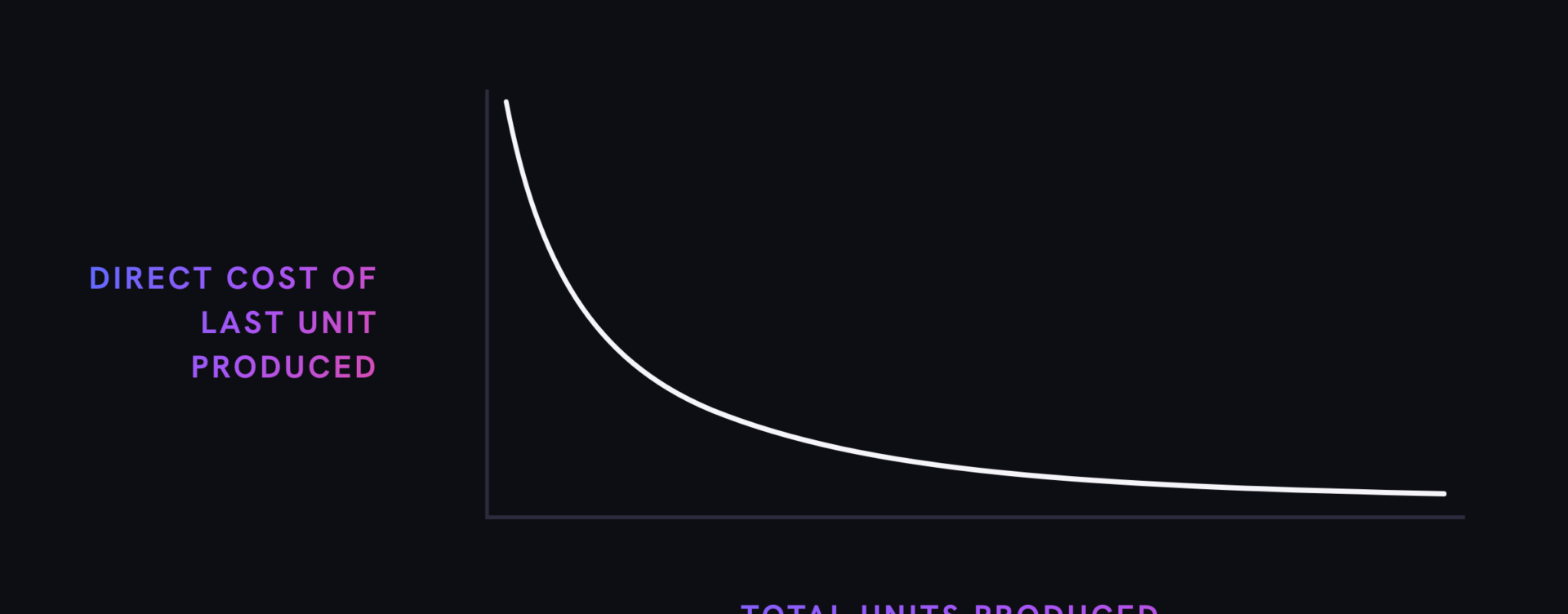
The important point to remember is that “accumulated production” starts with unit one, not the first produced that month or year, but the very first one off the assembly line using that manufacturing method. The strategic implications of the learning curve lie in moving down the learning curve before competitors do.
As a product matures in its product life cycle and becomes widely adopted, the curve becomes less useful.
Learning curves are not static. A new process or material may increase worker productivity and thus alter the curve.
That is called jumping to a new curve. In this situation, the running total of accumulated units produced is set to zero, and a new curve takes effect. With products that are continuously innovated, the learning curve is of little use. New curves are formed all the time, and there is not much time to “move down” any of them.
Differentiation
Differentiation is a prime marketing objective.
It involves making your product or service appear different in the mind of the consumer. With products, four levers do most of that work:
- Design — how the product looks, feels and behaves in the customer’s hands.
- Reliability — it does the same thing every time. This is what turns a first purchase into a repeat one.
- Service — what happens after the sale, when something goes wrong and the customer is deciding whether to come back.
- Delivery — getting it to them faster than the alternative, or simply on the date you promised.
With services, a point of differentiation can be employee courtesy, availability, expertise, and location. Products and services can be differentiated via advertising, even if they are virtually the same.
Focus
Using a focus strategy, a company concentrates on a market area, a market segment, or a product.
The strength of a focus strategy is derived from knowing the customer and product category very well.
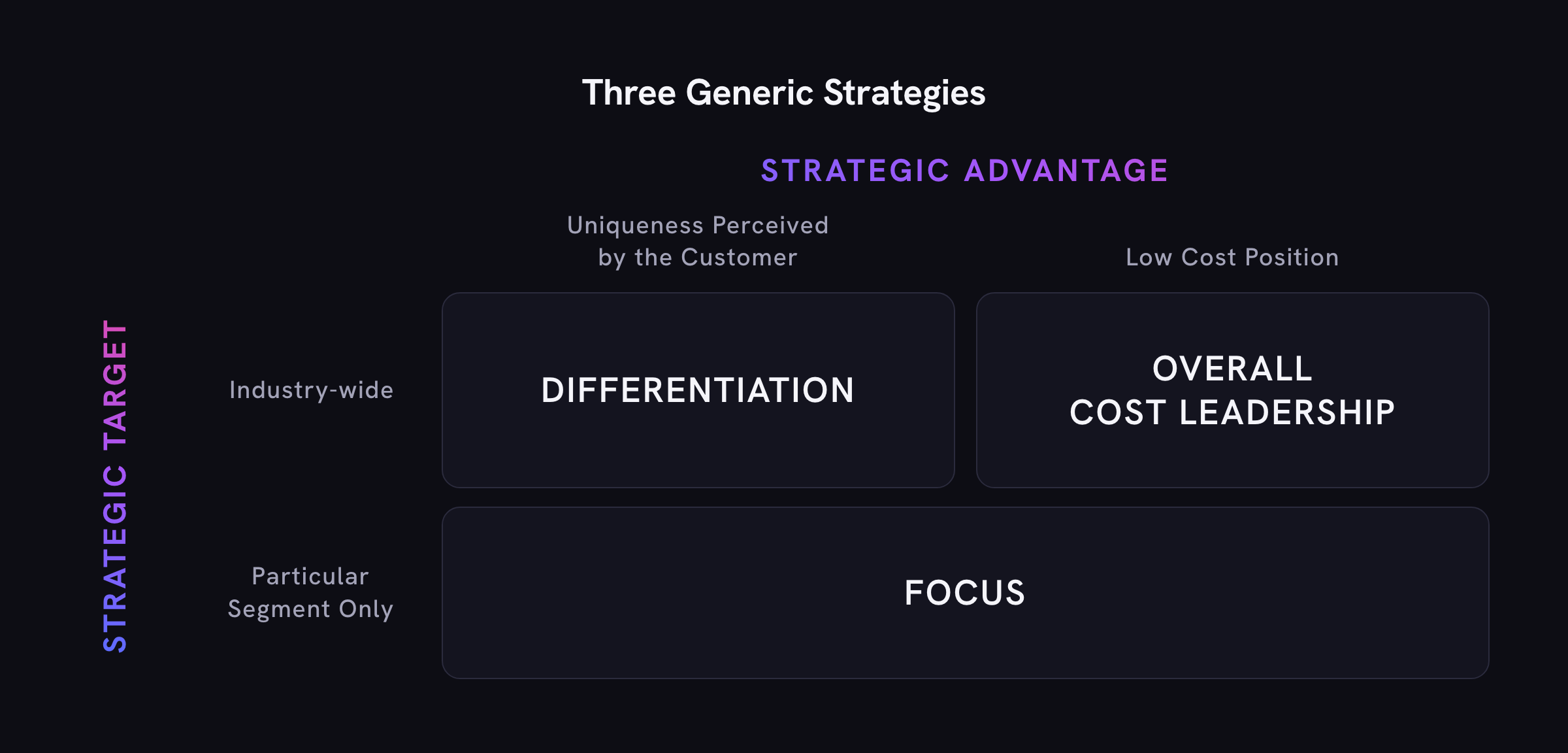
Strategy As Part Of An Organization: The Seven S Model
Two separate stages characterize strategic planning: formulation and implementation.
Thomas J. Peters, of In Search of Excellence fame, created the Seven S model showing that strategy ought to be interwoven within the fabric of an organization. Peters created the model with Robert H. Waterman and Julian R. Philips.
Their model provides a structure with which to consider a company as a whole so that the organization’s problems may be diagnosed and a strategy may be developed and implemented. If a strategy requires radical reorganization, it’s called reengineering. If not, it is described as “organizational tinkering”.
The Seven S’s are:
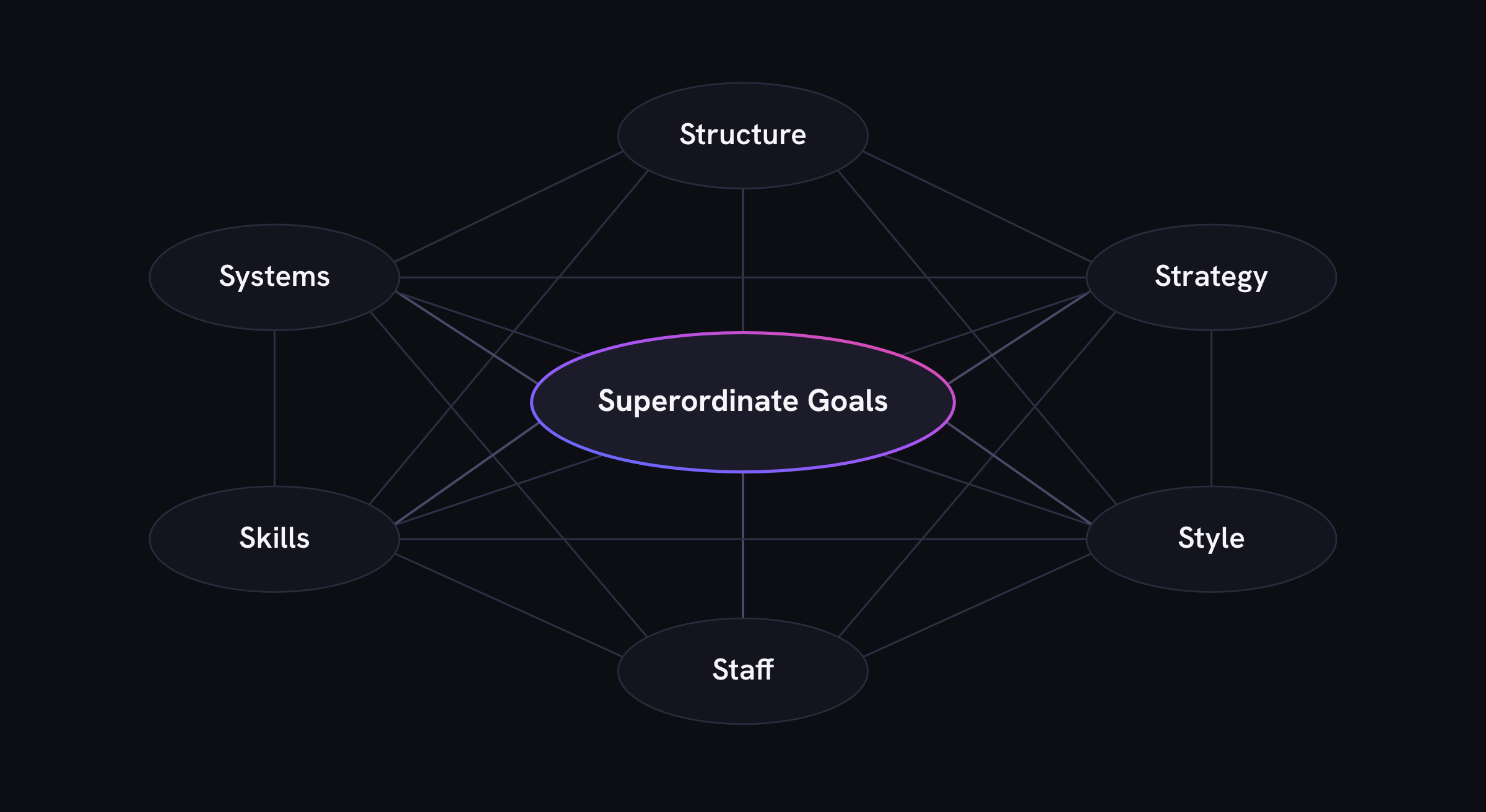
The diagram illustrates the “multiplicity” and “interconnectedness” of elements that influence an organization’s ability to change. There is “no starting point or implied hierarchy”. In an “excellent” organization, each of the S’s complement the others and consistently advances the company’s goal.
Structure
A corporation’s structure affects its strategic planning and its ability to change. A company’s structure may have a customer or a geographic focus.
Strategy
This refers to the actions that a company plans in response to or in anticipation of changes in its external environment, its customers, and its competitors.
Style
Culture or style is the aggregate of behaviors, thoughts, beliefs, and symbols that is conveyed to people throughout an organization over time. Since it is very hard to change a company’s ingrained culture, it is important to bear it in mind when developing a new strategy.
Staff
By staff, Peters means the human resource systems, which include appraisals, training, wages, and intangibles such as employee motivation, morale, and attitude. Without employee cooperation, a company will not have the ability to succeed.
Skills
Closely related to staff are the distinctive abilities and talents that a company possesses. Skills may range from the ability of staff to speak a foreign language to an understanding of statistics, to computer literacy, for instance.
Systems
The procedures, both formal and informal, by which an organization operates and gathers information, constitute the systems of a company. With this S, Peters is concerned with the systems that allocate and control money and materials as well as gather information.
Superordinate Goals
Super-ordinate goals are the guiding concepts – values and aspirations, often unwritten – that go beyond the conventional statements of corporate objectives. “Super-ordinate goals are the fundamental ideas around which a business is built.” Mission statements are often mentioned when companies speak about their goals.
A mission statement should be a short and concise statement of goals and priorities. The wording of the mission statement is often crafted to address the most important constituency at the time. Apart from the politics involved in its creation, a mission statement can be a useful super-ordinate goal, if it doesn’t have one.
The Value Chain and Integration
Value Chain
The next step for a strategic analyst is to assess the value a company adds to its products.
At each link in the chain, a channel participant (internal or external) adds value to the products as it makes its way to the consumer.
Supplier Value Chain > Firm Value Chain > Channel Value Chain > Buyer Value Chain
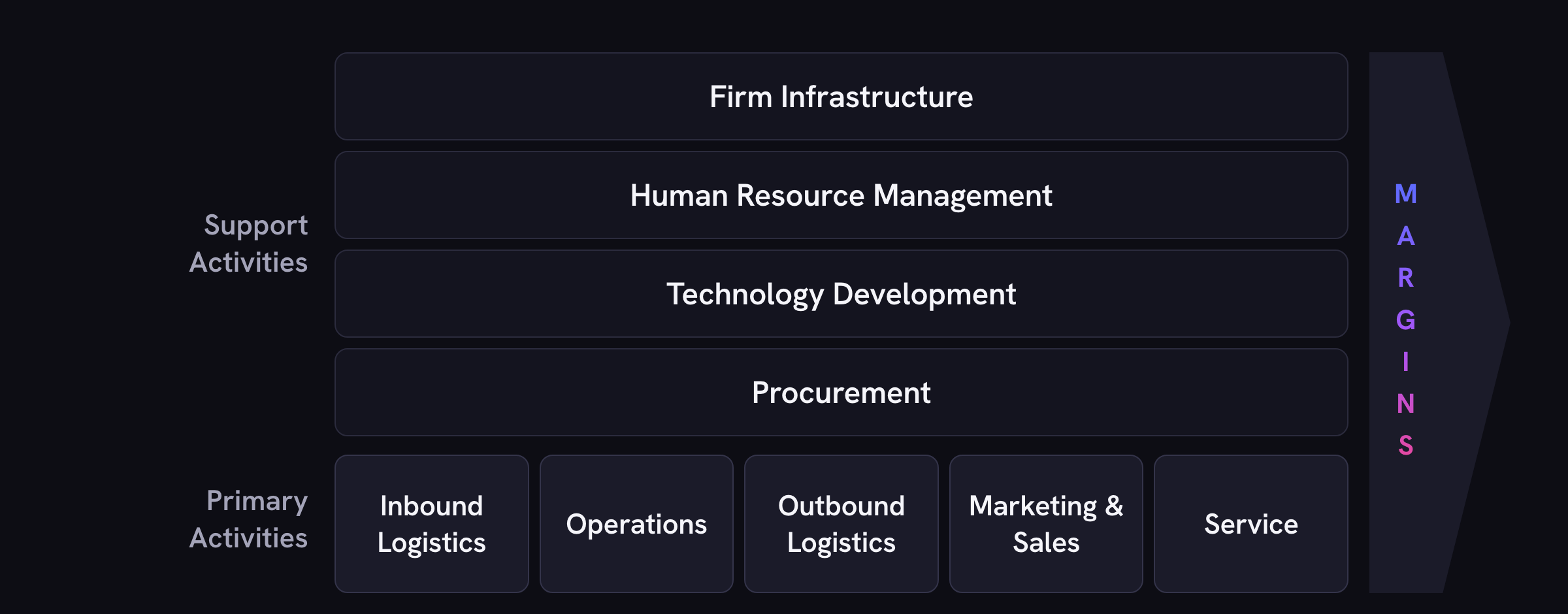
Strategic analysts review industries’ value chains to identify current and future sources of competition.
Integration
Forward and Backward Integration
When a company operates in areas further down the value chain, it is said to be forwardly integrated toward the consumer. If a business operates in areas closer to raw materials, then the company is said to be backwardly integrated. You can see a company as either forwardly or backwardly integrated depending on the point in the value chain at which you view that company.
Vertical and Horizontal Integration
Vertically integrated is a term used for companies that participate at many levels of the value chain in an industry. The term can describe both forwardly and backwardly integrated companies. The key is that several value-adding functions are being performed by one firm. Horizontal integration occurs when, for instance, a company acquires a competitor at the same level in the value chain.
Integration strategies may result in obvious benefits such as secured inputs and lower costs, but the disadvantages include higher exposure to the downturns in a single industry.
The Ansoff Matrix (Expansion Strategy)
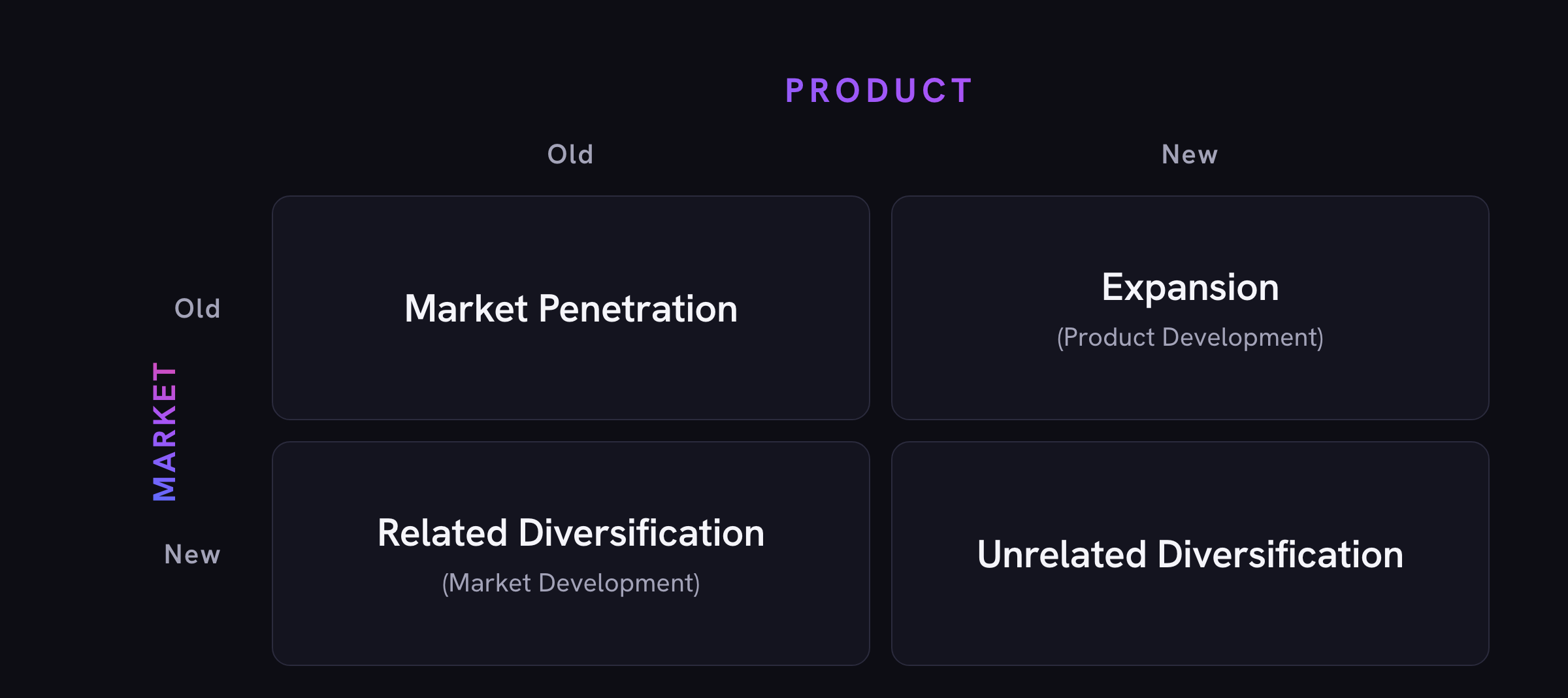
H.I. Ansoff created it in 1957 as a clear way to classify routes for business expansion. What determines the strategy classification is the newness of the product to the company and the firm’s experience with the intended market.
The “newness” of the product or market is determined by how “new” it is to the company contemplating the strategy, not by the age of the product or market itself.
Competitive Tactics: Signaling
Signaling is a key strategic tool.
It involves letting your competitors know what’s on your mind. Combatants signal what they plan to do or what steps they will take in response to a competitor’s move. Signaling is used to prevent disastrous (and costly) price wars.
Six common types of legal signals are worth knowing. The word legal is doing real work in that sentence: signaling is about making your intentions readable, and the moment it turns into an understanding with a competitor about prices, it stops being strategy and becomes collusion.
Price movements — you move a price partly to make money and partly to tell a rival what you are willing to tolerate. A cut aimed squarely at a competitor’s best-selling line is a sentence, not an accident.
Prior announcements — you say what you are about to do before you do it, to test whether anyone intends to fight you for it and to make sure nobody is caught by surprise. Announcing an expansion months ahead often does more work than the expansion itself.
Media discussions — an interview or a release explaining why you did something is aimed at your competitors as much as at your customers. It gives them your reasoning so they stop guessing at it.
Counterattack — when someone moves on your territory, you answer with a price cut or a promotion in theirs. The message is the cost of continuing, and it is aimed at the next decision rather than this one.
Announce results — you publish how an action actually turned out, so the competition draws the right conclusion instead of an expensive wrong one and answers a move you never made.
Litigation — you tie a competitor up in court. It is slow and it is costly on both sides, and it is often about the delay rather than the verdict.
Underneath all six sits game theory, the formal study of competitive interactions. It analyzes possible outcomes in situations where people are trying to score points from each other. In practice it means anticipating how your competitor will react to your next move, and factoring that reaction into the decision before you make it. A move that looks profitable on its own often stops looking that way once you assume the other side answers it.
Portfolio Strategies
A portfolio strategy is considered the highbrow area of corporate-level strategic planning. Theoretically, if a corporation could put together the right portfolio of unrelated and countercyclical businesses, it would be immune to economic downturns. However, this is only in theory, and in real-world settings, it’s not as simple.
Corporations want to know what business they should be in, which they should continue in, and which they should sell.
The Boston Consulting Group’s Growth/Share Matrix
The Boston Consulting Group (BCG) model uses market growth rates and relative market share to classify companies into four categories. Their studies showed that high market share was highly correlated with higher ROI (return on investment) and lower costs because of learning curve effects.
Therefore, the theory suggests that it is best to have a stable, high market share in some businesses to fund the cash needs of other businesses. There are four classifications that rest on that premise.
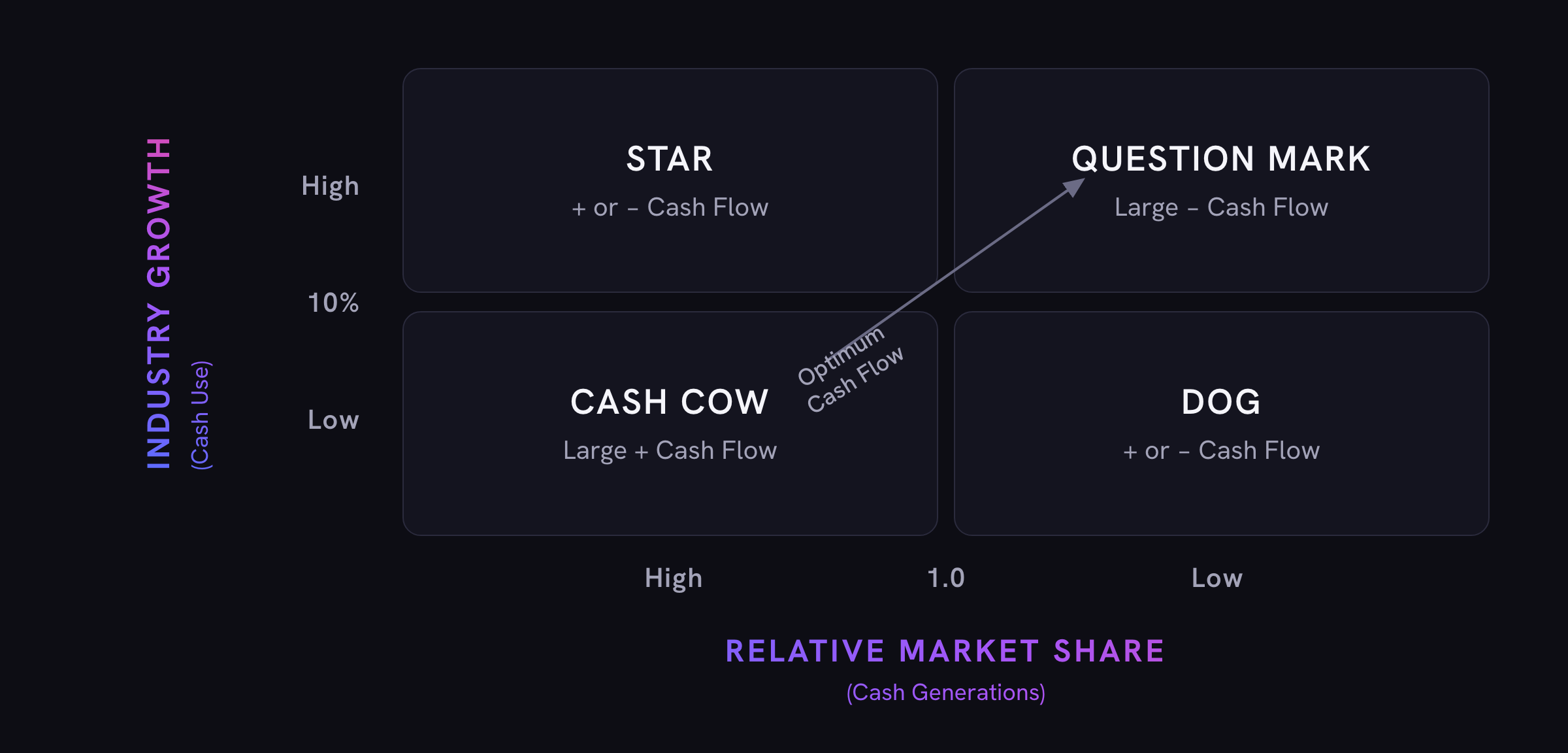
Star — a high-market-share business in a high-growth industry. Stars grow and finance themselves, which makes them look easy to run. They are not: they sit in the most competitive markets and need constant attention to hold the position they have.
Cash Cow — a high-market-share business in a low-growth industry. It throws off more cash than it needs, and that surplus is what funds everything else. The temptation is to starve it because it is boring. Starve it long enough and you lose the thing paying for the rest of the portfolio.
Dog — a small-market-share business in a low-growth industry. It goes nowhere while consuming corporate cash and, more expensively, management attention. A dog is not necessarily a bad business. It is simply not the kind of business a large corporation wants in its portfolio — which is exactly why dogs are often worth more to a smaller buyer than to the parent selling them.
Question Mark — a small-market-share business in a high-growth industry. It needs cash to grow. Succeed and it becomes a star, then eventually a cash cow. Fail and it either dies or becomes a dog as its industry matures. These are the real decisions in the matrix, because they are the only ones where funding or not funding changes the outcome.
Portfolio strategies have their drawbacks. They assume that businesses in a portfolio have no significant linkages, which is often not the case. Many collections of businesses share technical, marketing, and support functions.
You do not need a conglomerate for this to be useful. Run the same four boxes over your product lines, your branches, or your service offerings and the picture is usually uncomfortable in a helpful way: most owners are funding two question marks out of one cash cow and calling all three the business.
McKinsey & Company’s Multifactor Analysis
The model has two general variables that govern a business evaluation: industry attractiveness and business strength. Each variable is determined by a number of industry factors. In any given industry, some factors will be of greater importance than others. The six generic courses of action dictated by the model are:
- Invest and hold — keep funding it at roughly the current level to defend the position you already have.
- Invest to grow — put in more than the business currently returns, because the industry is worth owning a bigger share of.
- Invest to rebuild — the business has slipped and you are paying to recover a position, which is always dearer than holding one.
- Invest selectively — fund only the segments or product lines that are actually promising, and stop pretending the rest will come right.
- Harvest — take the cash out and stop reinvesting. You are deciding the business has a finite life and choosing to be paid during it.
- Divest — sell it, ideally to someone for whom it is a better fit than it is for you.
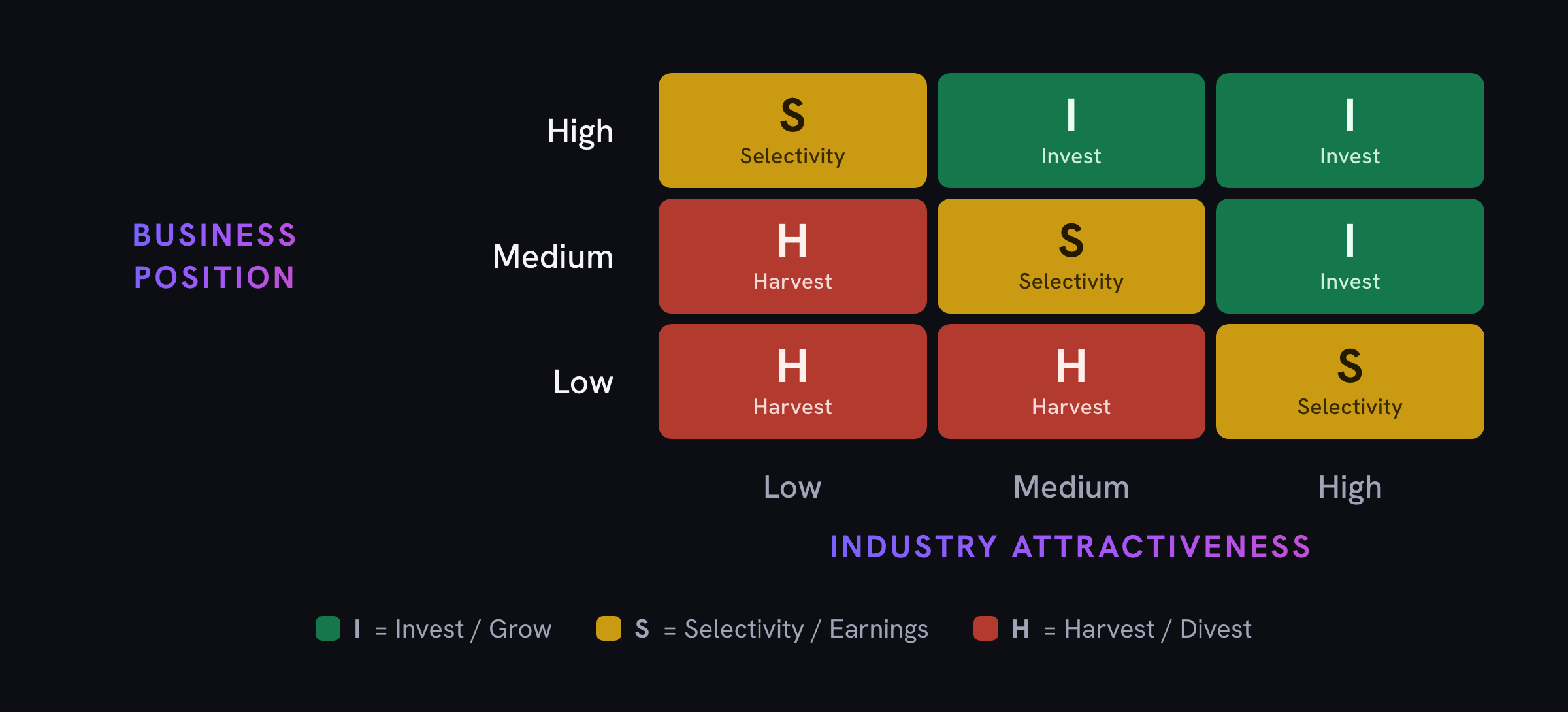
Although the McKinsey model is attractive because it takes into account many factors, nonetheless the evaluation is subjective.
Arthur D. Little’s SBU System
Arthur D. Little (ADL) has cooked up a system that revolves around the SBU, the strategic business unit. When similar businesses of a corporation are grouped into SBUs, portfolio strategies become less complicated because there are fewer units to worry about.
Businesses in different SBUs have little association with one another other than the financial ties imposed on them by the parent corporation. The ADL portfolio process has four steps:
- Classify all the businesses of a corporation into SBUs, grouping the ones that genuinely share customers, channels or technology.
- Place the SBUs into the matrix, positioning each by how mature its industry is and how strong its competitive position is within it.
- Evaluate the conditions of the industries in which each SBU operates, because the same competitive position means something very different in a growing industry than in a declining one.
- Make a decision — build, maintain or liquidate — and commit the funding that decision implies. A classification nobody funds differently is just a diagram.
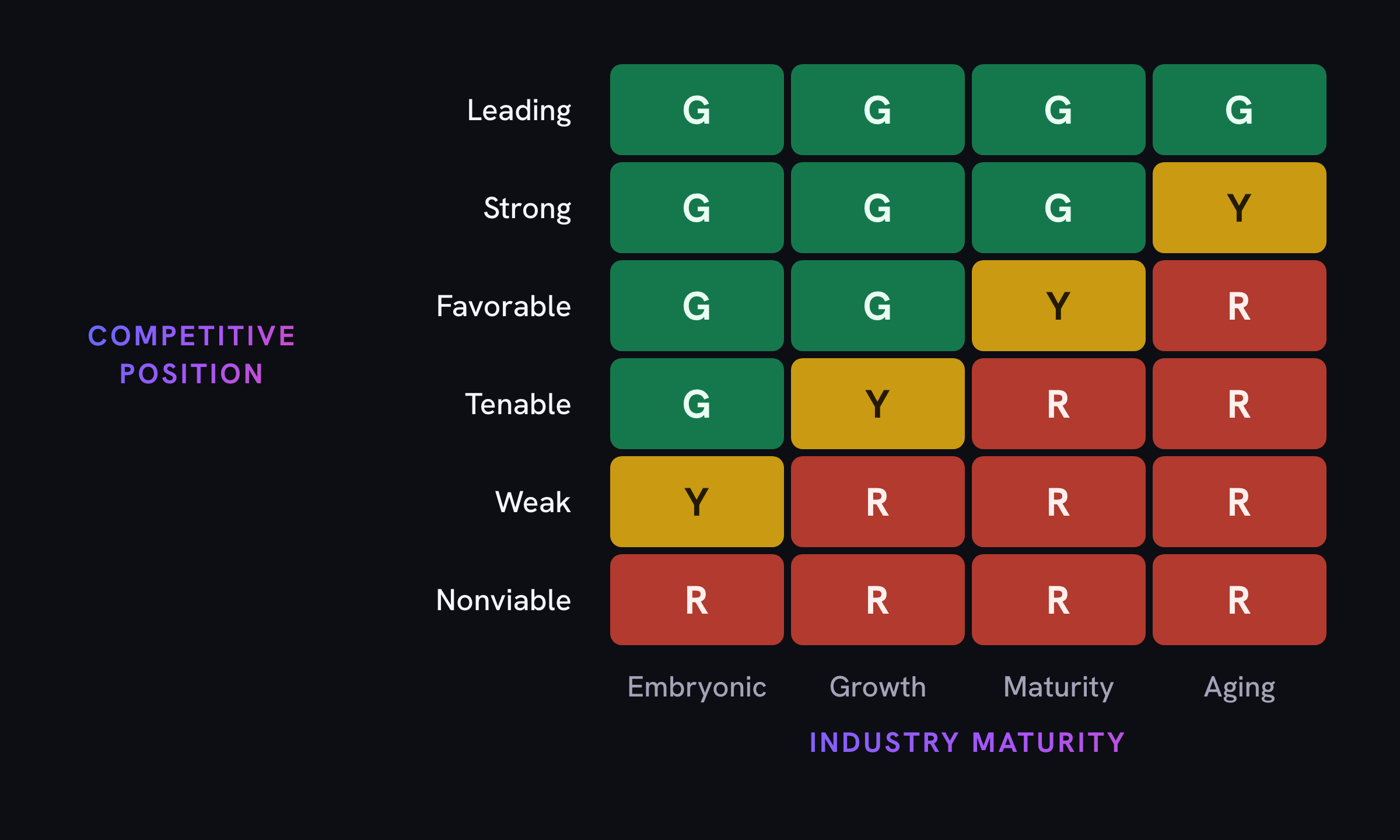
G, Y and R are the green, yellow and red bands of the original matrix.
The two variables that are operative in ADL’s model are industry maturity level and competitive position. The consultants devise appropriate strategies for each SBU owned: Build, Maintain, or Liquidate.
For green SBUs there are many different strategies available. For the red ones, the options available are constrained by the pool “conditions” in which they find themselves.
Once the SBU is classified, the consultants turn to their palette of generic strategies such as focus, penetration, or diversification to construct appropriate tactical plans.
Strategy Implementation
Concerns of a General Manager or CEO
Formulating the strategy is the easy half. Implementation is where it either becomes the way the company works or stays a document. Six things sit on the general manager’s desk, and each is covered in turn below:
- Human resource development — whether the people you already have can execute the strategy you just chose, and who is training them if they cannot.
- Organizational structure — who owns which decision. Structure either speeds a strategy up or quietly blocks it, and it usually does the second one without anybody saying so.
- Management control systems — what you measure and what you pay for. This is where a strategy turns into behavior, or fails to.
- Organizational culture — what people do when no one is checking. A strategy that contradicts the culture loses, every time.
- Politics and regulatory issues — the internal relationships you have to keep working, and the outside agencies whose rules set the boundaries of what you can do at all.
- Organizational change and renewal — how you get from the current way of working to the new one without losing the people who have to do the work.
The issues and concerns that a CEO or general manager must address in strategy implementation were presented separately and by topic in this paper. In real business situations, the CEO is faced with issues at the same time and may even be recurrent, and changing depending on the internal and external environment of the firm.
The point is that the leader of the organization cannot assume that there is a definite end to the resolution of issues. Thus, a leader of the organization needs to have a management team that will assist him in the implementation of strategies.
Human Resource Development
Training is what closes the gap between the strategy on paper and the skills actually present in the building. The useful question is not “what training should we run” but “what does this strategy require people to be able to do that they cannot do today”. Four categories of need come out of that question:
- Short-term needs, meaning inside about 60 days — the things that will hurt you this quarter if you leave them.
- Entry-level programs, so new hires reach useful output in weeks rather than months.
- Training on new regulations that affect the firm, because the cost of getting these wrong is a penalty, not a missed opportunity.
- Training for the sales force, which is usually the first group to feel a change in strategy and the last group told about it.
- Long-term needs — capability you are building deliberately, and which follows directly from the generic strategy you picked.
- If you are competing on cost leadership: cost analysis, product costing, cost allocation and production processes. You cannot drive down a cost your people cannot measure.
- If you are competing on market leadership: product development, market research, consumer behavior, economics and industry analysis.
- Expansion into other markets — both the people you hire abroad and the people you send there need preparing.
- Short- and long-term programs covering language, local law and how to market in that country. This is the training most often skipped, and it is why capable managers fail in an unfamiliar market.
- Technological change — new systems change what the job is, so the job description has to change with them.
- Redesigning or enriching roles, and creating new positions the technology now requires.
- Updating job specifications, short- and long-term, so operations continue while the technology is being adopted rather than pausing for it.
Organizational Structure
Two structures come up most often once a company is running more than one line of business.
Multi-divisional structure — each operating division carries its own profit responsibility, while the corporate level keeps the shared functions such as HR, finance, legal and accounting. The division runs the business; the centre sets the rules and holds the scoreboard.
Holding company — the parent owns shares in subsidiary corporations rather than running them, and exercises control through board seats and the officers it appoints, such as the president and treasurer. Control here is ownership and appointment, not day-to-day management, which is exactly why it is the structure families use when the next generation is not ready to operate the business.
Organizational Change and Renewal
John P. Kotter of Harvard Business School set out this eight-step sequence for leading change in 1995. The order matters more than the list does: most failed change programmes skip a step early and pay for it late.
- Establish a sense of urgency — people do not leave a comfortable status quo for an argument. They leave it for a threat or an opportunity they can see themselves.
- Form a powerful guiding coalition — enough authority and enough credibility in one group to make the change stick. Include the dissenters: listening to the opposition is how you find out whether the proposed change survives contact with the people who will have to run it.
- Create the vision — a picture of the finished state clear enough that someone can act on it without asking you. Attach the motivation and the incentives here, because a vision nobody is rewarded for reaching is a poster.
- Communicate the vision — repeatedly, and in the channels people actually use. Under-communicating is the most common failure in this sequence, usually because leaders assume that having said it once means it was heard.
- Empower people to act on the vision — remove the approvals, systems and job descriptions that make the new behavior harder than the old one.
- Plan for and create short-term wins — set them against real targets and milestones so they are visible proof rather than encouragement. Give the guiding coalition key performance indicators and controls, so progress is something you can see rather than something you feel.
- Consolidate the gains and produce more change — use the credibility the early wins bought to take on the harder structures. Declaring victory here is what lets the old way return.
- Institutionalize the new approaches — anchor them in how you hire, promote and measure. Change survives when it is in the systems, not when it is in the enthusiasm of whoever led it.
Reengineering and Incrementalism
Reengineering — the fundamental rethinking and radical redesign of business processes to achieve dramatic improvements in the measures that matter, such as cost, quality, service and speed. The word radical is the point: reengineering replaces a process rather than tuning it.
Incrementalism — the opposite approach, and the one large companies actually use most of the time. Strategic change arrives fragmented, evolutionary and intuitive, with no rigid timetable and no clean beginning or end. It is less satisfying to describe and it is usually what survives.
Organizational Culture
Basic assumptions that are shared by a group and which have been found to be valid in the past so they can be taught to newcomers in the organization.
People and organization leaders create and change the culture.
Leaders, particularly visionary and articulate leaders, define and institutionalize the organization’s culture
Culture is not decoration. It does three jobs, and a firm notices it most when one of them is failing:
- External adaptation and survival — the shared answer to how this company competes and what it does when the market shifts.
- Internal integration — how people here work with each other, settle disagreements, and decide what is acceptable without being told.
- A sense of identity — what employees believe they are part of. This is the one that keeps good people through a bad quarter.
Management Control Systems
Designed to address agency problem to minimize the gap between the individual manager’s goals and organization’s goals.
Key elements:
Management Control Structure
| Type | Selected Criteria for Performance Measurement |
| Revenue Centers | Revenues or Market Share |
| Discretionary Cost Centers | Costs vs Accomplishments |
| Engineered Cost Centers | Actual costs vs Standard Costs |
| Profit Centers | Sales Minus Costs and Expenses |
| Investment Centers | Return on Investments |
Management Control Process
- Decide what gets measured — set the criteria each unit will be judged on. Choose these carefully, because people optimise for whatever you pick, including when it is the wrong thing.
- Measure, report and review — against those criteria and on a fixed rhythm. A number reported late is history; a number reported on time is a decision.
- Reward on performance — pay the managers of key operating units against what was measured. Skip this step and the first two become paperwork.
Politics and Organizational relationships
Every organization runs on a set of relationships that have to be actively managed. Left alone they do not stay neutral, they sour. These are the internal ones:
- The president and the board — the board sets direction and judges performance; the president runs the company. Trouble starts when either one starts doing the other’s job.
- Line and staff — the people who produce the revenue and the people who support and control them. Line sees staff as overhead, staff sees line as undisciplined, and both are occasionally right.
- Between departments — most of these conflicts are structural rather than personal, which is why replacing the people rarely fixes them.
- Marketing and production — marketing promises variety and short lead times; production is measured on efficiency, which wants the opposite.
- Marketing and accounting — marketing wants to spend to build demand; accounting wants the spend justified before it happens.
- HR and everyone else — HR carries policy the other departments experience as friction.
- Boss and subordinate — the relationship that determines whether the strategy is executed or merely acknowledged. There is a section on managing this one further down.
- Union and management — a formal relationship with its own rules, where the cost of handling it badly is measured in stoppages rather than in atmosphere.
The same is true outside the company. These relationships are managed by someone whether or not you assign them:
- Suppliers — the relationship that determines your input costs and, more quietly, whether you get supplied at all when stock is short.
- Customers — especially the concentrated ones. Any customer large enough to hurt you by leaving is a strategic relationship, not an account.
- Owners and management — whoever put in the capital wants a return and a say. In family businesses these two are the same people wearing different hats on different days, which is its own problem.
- Government and the public sphere — legislators, agencies such as the BIR, SEC and BSP, the courts, activists and the media. You do not have to like this arena to be operating in it.
- Regulators — treated separately below, because in a regulated sector the regulator effectively sets the boundaries of your strategy.
Regulatory Issues
Laws and regulations impact on the operations of the business firms.
In the Philippines, some industry sectors are regulated. Extent and control by regulatory agencies vary for each industry.
- Water — the Metropolitan Waterworks and Sewerage System (MWSS), through its Regulatory Office, in Metro Manila; water districts elsewhere fall under the Local Water Utilities Administration (LWUA).
- Power distribution — the Energy Regulatory Commission (ERC), which approves the rates a distribution utility may charge.
- Banking — the Bangko Sentral ng Pilipinas (BSP), which sets capital, reporting and conduct requirements.
- Insurance — the Insurance Commission (IC), which also supervises pre-need and HMO companies.
- Telecommunications — the National Telecommunications Commission (NTC), which controls frequencies and service standards.
- Everyone else — the BIR, the SEC and the DTI reach every firm regardless of sector, which is why an unregulated industry is not the same thing as an unsupervised one.
The Roles of the CEO
According to Erlinda Echanis, professor emeritus at the UP College of Business Administration, University of the Philippines Diliman, the main objective of the CEO is to drive the business from the current situation (the status quo) to the destination (the vision). The CEO acts as the driver of the vehicle, and the vehicle is the business.
In order to do so, the CEO must not rely on the tools of strategic planning. The CEO must determine the CRITICAL SUCCESS FACTORS that are the determinants of success. 80% of the results are driven by 20% of the factors. Correctly identifying the 3 best critical success factors of any business shall greatly simplify the strategic planning process of the business.
By conducting a gap analysis of the status quo and the vision based on the critical success factor, the CEO has the lead on what to prioritize on the strategic plan that will minimize the gap between the goals and the existing capabilities/state of the company.
In the process, the CEO may have the need to fire employees and managers.
Set up high standards that are appropriate to establish a culture of winning. With that said, the CEO job demands successful action in a variety of roles that differ according to the nature of the problem observed or decision pending, the needs of the organization or the personality and style. The CEO may have the need to preside over technical capabilities that they cannot possibly have personal expertness. This includes the know-how on markets and ways in which they are changing
CEOs are obliged to put behind specialized apparatus their education and functional experience have provided.
E.g. engineers running their companies strictly as engineers will encounter financial and marketing problems
The behavior of a CEO for Strategic Planning
Interpersonal
The ten roles that follow are Henry Mintzberg’s, drawn from his study of what managers actually spend their days doing rather than what the job description says. They divide into three groups. The first is interpersonal:
- Figurehead — the ceremonial duties that come with the office. Easy to dismiss as theatre, until you are the one whose absence at a wake or a launch gets noticed.
- Leader — directing and motivating the work of the organization and the unit, and being answerable for what it produces.
- Liaison — the contacts you maintain outside your own unit. This is the role most managers under-invest in, and the one that supplies information no internal report will give you.
Informational
- Monitor — you scan constantly for information about the business and its environment, most of it arriving informally rather than through the reporting line.
- Disseminator — you pass what matters down and across, inside the company. Hoarding information feels like authority and behaves like a bottleneck.
- Spokesman — you speak for the organization to the outside: customers, regulators, lenders, the press.
Decisional
- Entrepreneur — you initiate change deliberately, looking for improvements rather than waiting for problems to force them.
- Disturbance handler — you deal with the crises nobody planned for. Spend your whole week here and the entrepreneur role never happens, which is how a company drifts.
- Resource allocator — you decide where the money, the people and your own attention go. This is the role where strategy is really made, whatever the plan document says.
- Negotiator — you commit the organization in dealings with suppliers, customers, unions and partners, because you are the one who can.
Roles of the CEO
Organization leader
Organization leader requires securing the attainment of planned results in the present and developing an organization capable of producing both technical achievement and human satisfactions. It also involves planning and executing policy decisions affecting future results. The functions to become an organizational leader are as follows:
- Achieving acceptable results against expectations. This requires you to stay continually informed and ready to intervene when results fall below what was planned. Changing circumstances and competitor moves produce emergencies that upset well-laid plans, so in practice this function is mostly resourcefulness under pressure rather than adherence to the plan.
- Creating and maintaining the capability that makes those results possible. This means integrating the specialist functions — marketing, R&D, manufacturing, finance, control and personnel — which multiply as technology develops and each of which, left alone, pulls the company in its own direction.
The second function is the harder one, and it asks for a specific set of skills. You act as taskmaster, which means going beyond insisting on planned results to asking why the organization cannot yet produce them. You act as mediator between functions whose objectives genuinely conflict. You act as organization designer, since the formal structure you put in place is the blueprint for how cooperation is meant to happen. Underneath all three sits the ability to educate people, motivate them, and evaluate their performance honestly.
The perspective demanded is an uncomfortable one to hold: the primacy of the organization’s goals and the validity of the individual’s goals, at the same time, without pretending either one away. It also demands visible impartiality toward the specialist functions, and criteria that let you allocate resources against documented need rather than against whoever argues hardest in the room.
Personal leader
The personal leader role requires a distinctive personal contribution. Your behavior is the signal others navigate by, and you are the culture made visible to staff, customers and anyone else watching.
- You contribute as a person, not only as an office. Chief executives affect the quality of life and the level of performance in their organizations whether they are dynamic or colorless. Neutral is not one of the options.
- Where policy cannot be written without becoming absurdly detailed, your own conduct is the policy. People read the moral and ethical standard off what you do far more reliably than off any statement of values.
- By who you are, as much as by what you say, you influence the organization, shape how individuals develop, and set the level of performance that everyone comes to regard as normal.
- The skills this calls for are communicator, exemplar, and the ability to attract respect or affection. Integrity sits underneath all three: without it, persuasion reads as manipulation and the other two stop working.
- The point of view required is two-sided — acknowledging your own needs and integrity as a person, while genuinely accepting that other people’s points of view, behavior and feelings matter as much to them as yours do to you.
- Self-awareness is what makes the rest usable. It acquaints you with your own strengths and weaknesses, which is the difference between leading deliberately and leading by temperament.
- Formal authority still counts, but only so far. Announced policy backed by the chief executive can be made effective through clarity of direction, close supervision and the enforcement of sanctions — and it will still not reach the behavior nobody is watching. That part is carried by example.
The chief architect of organization purpose & culture
As the chief architect, the CEO requires developing an organization capable of producing both technical achievement and human satisfactions. This is possible through the installation of a culture based on the CEO as a leader.
- In a new organization the job is entrepreneurial and improvisatory. There is no established way of doing things to manage, so you are inventing it while trading.
- In a long-established one you are the manager of the purpose-determining process and the chief strategist. The company already has a way of doing things; your work is to decide what it is for now, and to change it without breaking it.
- Lead strategy and implementation, but leave others a real opportunity to influence both. Consultation that cannot change the outcome is quickly recognised for what it is.
- Goals have to be known and accepted, not merely announced. Planned results come from goals and means so thoroughly accepted that they draw extraordinary effort and ingenuity out of people.
- People who believe top management is open to influence will bring you the opportunity. They will go out of their way to report what they have seen, through whatever channel is open. People who believe otherwise sit on it, and you never learn what you missed.
- Effective general managers show through their actions that building a cooperative, creative organization matters as much as laying plans and measuring against them. Staff work out which of the two you actually value within about a quarter.
- Seek amendment, acceptance and understanding before a change lands. Done that way, the process of change itself becomes an experience that reinforces the leader’s commitment to the members rather than spending it.
- To tap the energy and creativity your employees already bring to the job, involve them in the processes that shape the strategic parts of their own work. It is not there to be extracted; it is offered, and only to people who are asked.
All of it rests on one underlying demand: comprehend the complexity, put your past experience into a new perspective, and understand the world you have been put in charge of rather than the one you trained for.
Organizational structure and controls
- Every firm needs some structure to implement a strategy. Even a business run entirely out of the owner’s head has one; it is simply undocumented and known only to him.
- Structures get changed when they stop working — specifically, when they no longer supply the coordination, control and direction that managers need to execute the strategy.
- Organizational structure is the firm’s formal configuration of roles, procedures, governance and control mechanisms, and its authority and decision-making processes. It is shaped by situational factors such as the company’s size and age, and it reflects management’s judgment about what the firm does and how it gets that work done, given the strategy it has chosen.
- Strategic competitiveness arrives only when structure fits strategy. A strategy’s potential to create value is reached only if the firm configures itself in a way that lets that strategy actually be executed.
- A new strategy usually requires a new structural arrangement. Keeping the old structure is the quietest way to guarantee the new strategy underperforms.
- The influence runs both ways. Existing structure shapes which strategies get chosen next, because the options that fit the current organization are the ones that look reasonable. Formulation and implementation interact continuously rather than running in sequence.
Simple Structure versus Functional structure
| Type | Nature | Firms’ Strategies | Advantages / Disadvantages |
| Simple Structure | An organizational form in which the owner-manager makes all major decisions directly and monitors all activities, while the staff serves as an extension of the manager’s supervisory authority. Little specialization of tasks, few rules and limited formalization. Information systems are unsophisticated. Communication is frequent and direct. New products tend to be introduced to the market quickly. Few coordination problems. | Focused cost leadership. Focused differentiation. Restaurants, repair businesses and other specialized enterprises. | Broad-based openness to innovation. Greater structural flexibility. Ability to respond more rapidly to environmental changes. |
| Functional Structure | Consists of a CEO and a limited corporate staff, with functional line managers in the dominant organizational areas such as production, accounting, marketing, R&D, engineering and HR. Allows functional specialization, which facilitates knowledge sharing and idea development. The CEO integrates the decisions and actions of the individual business functions for the benefit of the entire corporation. Facilitates career paths and professional development. | Tendency for functional-area managers to focus on local rather than overall company strategic issues. Risk of losing sight of the firm’s overall strategic intent and mission. Solution: the multi-divisional structure. It allows for greater diversification, and strategic success often leads to growth and further diversification. |
Definitions:
- Specialization — the type and number of job specialties needed to do the firm’s work. More specialization buys depth and costs flexibility, because a narrow role cannot easily cover for another one.
- Centralization — how much decision-making authority is kept at the higher management levels. High centralization gives consistency and slows everything to the speed of the person at the top.
- Decentralization, which is where the trend has been going — pushing decision authority down to the people in the most direct and frequent contact with customers. It works when those people have the information and the judgment to use it, and it fails loudly when they have only the authority.
- Formalization — the degree to which written rules and procedures govern what happens. Too little and every case is decided from scratch; too much and the rules start substituting for thinking.
Structures for generic Strategies
| Cost | Differentiated | Cost / Differentiated |
| Operations is the main function. Overall structure is mechanistic; job roles are highly structured. Strong task specialization. Centralization of decision-making authority. A relatively large centralized staff coordinates functions. Formalization of work rules and procedures. Process engineering is emphasized rather than new product R&D. | Marketing is the main function. Overall structure is organic; job roles are less structured. New product R&D is emphasized. Most functions are decentralized, but R&D and marketing are centralized, with the central staffs working closely with each other. Formalization is limited, so that new product ideas can emerge easily and change is more readily accomplished. | Seeks to provide value that differs from what is offered by the cost leader and by the leading differentiated firm. Difficult to implement, because the strategic and tactical actions required for the two strategies are not the same. On the low-cost side, emphasis is placed on production and manufacturing process engineering, with infrequent product changes. On the differentiated side, marketing and new product R&D are emphasized. The challenge is to form an organizational structure that allows the development of differentiated product features while costs are reduced. It is supplemented by horizontal coordinators, cross-functional teams and a strong organizational culture. Toyota Motor Corporation is the example: differentiated design and manufacturing processes implemented concurrently through its integrated product design process. Integrated cost leadership and differentiation strategies are implemented by global firms. |
Multi Divisional Form
| Cooperative Form | Strategic Business Units (SBUs) | Competitive Form | |
| Definition | Cooperative form – uses many integration devices and horizontal HR practices to foster cooperation and integration among the firm’s divisions | Consists of at least 3 levels, the top-level being corporate HQ, the next, SBU groups, and final level, divisions groups by relatedness (through either a product or a geographic market) within each SBU | Controls used emphasize competition between (usually unrelated) divisions for corporate capital |
| Characteristics | Structural integration devices crate tight links among all divisions. The corporate office emphasizes centralized strategic planning, HR, and marketing to foster cooperation between divisionsR&D – likely to be CentralizedRewards are subjective and tend to emphasize overall corporate performance, in addition to divisional performance. Culture emphasizes cooperative sharing | Structural integration among divisions within SBU’s, but independence across SBU’sStrategic planning – the most prominent function of HQ for managing the strategic planning approval process of SBU’s for the CEOEach SBU may have its own budget for staff to foster integration]Corporate HQ staffs serve as consultants to SBUs and divisions, rather than having direct input to product strategy, as in the cooperative form | Corporate HQ has small staff Finance and auditing – most prominent functions in HQ to manage cash flow and ensure the accuracy of performance data coming from division legal affairs function becomes important when the firm acquires or divests assets. Divisions: independent and separate for financial evaluation purposes to retain strategic control, but cash is managed by the corporate office |
| Centralization | Centralized at corporate office | Partially centralized (SBUs) | Decentralized to divisions |
| Use of integration mechanisms | Extensive | Moderate | Nonexistent |
| Divisional performance appraisal | Emphasizes subjective criteria | Uses of a mixture of objective and subjective criteria | Emphasizes objective (Financial or ROI) criteria |
| Divisional incentive compensation | Linked to overall corporate performance | Mixed linkage to corporate, SBU and divisional performance | Linked to divisional performance |
| Example | IBM – facilitating e-commerce services | Sony, GE – integration among divisions within SBUs but independence between SBU’s, NBC | Pacific Dunlop – Australia’s most diversified company; strategy – market a multitude of brand name consumer products as a mass retailer – with emphasis on brand’s equity and profitability |
The effect of structure on strategy:
M-form is a structural innovation intended to help managers deal with coordination and control problems created by increasing product and market variety
The disadvantage of M-form:
- It encourages diversification past the point where diversification pays. Adding another division is structurally easy in an M-form, so it keeps happening after the strategic reason for it has run out.
- Focus gets diluted. Corporate attention is finite, and every additional division takes a share of it regardless of how much it contributes.
- The evidence points the same way — reductions in the diversified scope of M-form firms have been associated with improvements in shareholder wealth. Narrowing has often been worth more than expanding.
Implementing International Strategies:
| Worldwide Geographic Area Structure | Worldwide Product Divisional Structure |
| Emphasizes national interests, and facilitates managers’ efforts to satisfy local or cultural differences. | Standardized products are offered across country markets, and the firm’s home office dictates competitive advantage. International economies of scale and scope are sought and emphasized. |
| The perimeter circles indicate decentralization of operations. Emphasis is on differentiation by local demand, to fit an area or country culture. Corporate HQ coordinates financial resources among independent subsidiaries. The organization is like a decentralized federation. | Corporate indicates centralization, to coordinate information flow among worldwide products. It uses many intercoordination devices to facilitate global economies of scale and scope, and it allocates financial resources in a cooperative way. The organization is like a centralized federation. |
| Integrating mechanisms. Requires little coordination between different country markets, so there is no need for integrating mechanisms among divisions. Formalization is low, and coordination among units is often informal. | Integrating mechanisms. Creates effective coordination through mutual adjustments in personal interactions: direct contact among managers, liaison roles between departments, temporary task forces or permanent teams, and integrating roles. A shared vision of the firm’s strategy and structure is developed through standardized policies and procedures (formalization) that facilitate the implementation of this organizational form. |
| Inability to create global efficiency. There is a need to pursue worldwide economies of scale and scope. | Difficulty involved in coordinating decisions and actions across country borders, and an inability to respond quickly and effectively to local needs and preferences. |
| Developed originally by friends and family members of the main business, who were sent as expats into foreign countries to develop an independent country subsidiary. | For rapidly growing firms seeking to manage their diversified product lines effectively. Example: P&G. |
Transnational Strategy
- It uses a combination structure, running geographic divisions and product divisions at the same time rather than choosing between them.
- It is trying to have both things at once — the local responsiveness that a multi-domestic strategy is built for, and the global efficiency that a global strategy is built for.
- Both structures carry real weight, which is the source of the difficulty: a country manager and a product manager can each have a legitimate claim on the same decision, and somebody has to arbitrate.
Building Organizational Capabilities
The work environment inside a company shapes the values and the skills of the people who will run it later, and it holds the place together as those people come and go. It is the personality of the business, and it is specific to that business — no two are the same. It is what gives the work meaning and what gives people something to identify with beyond the pay. Most usefully, it supplies decision criteria that nobody ever wrote down: when a staff member faces a call you never anticipated, the work environment is what decides it.
Tailoring the organization to strategy
Structure has to be tailored to the strategy you actually chose and to the conditions you are actually operating in. Get that wrong and capable people underperform for reasons that look like attitude problems. These steps rarely run in a neat order — you will work several in parallel, and sometimes in reverse.
- Name the key tasks and the decisions. Before you draw a single box, be clear about what work has to get done and which decisions the strategy actually requires. Most structures disappoint because they were copied from another company rather than derived from the work.
- Assign responsibility for those tasks and decisions to specific people or teams, in a way that lets them perform rather than in a way that looks tidy on paper. This is also where you take an honest reading of what your people and units can do relative to your competitors, not relative to last year.
- Put in formal coordination. The moment you divide work, you create seams. Coordination is what stops the seams from becoming the place where things quietly get dropped.
- Build the information systems that make coordination possible. Divided functions cannot coordinate on goodwill. They need the same numbers, at the same time, in a form everyone reads the same way.
- Sequence the work. Turn the tasks into a program of action, or a schedule of targets with dates against them. An unsequenced plan is a wish list.
- Only then staff it. Once the basic structure is settled, recruit and assign people to the essential tasks according to the skills they have or can realistically develop. Building the structure around whoever happens to be available is how you end up rebuilding it every time somebody resigns.
- Compare actual performance against the plan. Use the formal reports and the judgment of managers and customers both, measured against plans and standards. You are reading three separate things: what the organization achieved, how competent the individuals and units are, and whether your internal standards were any good in the first place.
- Check that pay and incentives point the same way as the strategy. Look at how individual performance is measured, in numbers and in judgment, and make sure it lines up with the company’s goals. People optimize for what gets rewarded, every time, whatever the plan says.
- Set the boundaries. Constraints and controls, formal and informal, exist to contain the behavior you do not want and to enforce standards — ethical standards above all. Incentives without boundaries reliably produce something you will have to explain later.
- Keep developing technical and managerial skills. This is a standing priority tied to what each person is responsible for, and it is separate from the one-off training you run to get a reorganization working. The reorganization training ends. The development does not.
- Lead it energetically. No structure grows or achieves anything on its own. Someone has to keep pushing it, and in most MSMEs that someone is the owner.
Building Organization Capability
Capability is not something you announce. It gets built through a handful of ordinary practices, repeated until they are simply how the company behaves.
- Stay open to influence. Effective owners and general managers lead both the strategy and its implementation, but they deliberately leave other people room to influence them. When your staff believe you will actually listen, they go out of their way to bring you the problem or the opportunity early, through whatever channel is open to them. When they believe you will not, you get the news last.
- Involve people in the decisions that shape their own work. The energy and creativity your employees bring to the job is mostly latent, and it stays latent if the strategic parts of their work are settled somewhere they are not in the room.
- Use capital budgeting to manage cash deliberately. Deciding in advance what gets funded is a capability. Deciding as each request lands on your desk is a habit, and an expensive one.
- Run problem-solving teams. Point them at the issues that are pressing now, and at the openings to grow that nobody currently owns.
- Make delegation and empowerment the organizing principle. Not a favor you grant when you are too busy, but the default way the company is arranged. An owner who cannot do this stays the bottleneck no matter how large the business gets.
Organizational capabilities of CEOs
As CEO or GM build new capabilities, they must attend to maintaining and renewing old ones from time to time. If maintenance is neglected, core organizational capabilities erode. If renewal activities are absent, the capability may become obsolete.
Basic skills have to be maintained at the same time the new systems of offense and defense are being developed and deployed. It helps to keep four related things apart here, because they all get called “capability” in conversation and they are not the same thing:
- Organizational resources — what the company has. People, equipment, cash, locations, licenses, brand. This is the inventory, not the ability.
- Organizational competencies — what the company is good at. A competence is a resource plus the skill to use it well and repeatedly.
- Organizational capabilities — what the company can reliably deliver by combining competencies across functions. Any one department can be good on its own; capability is when the whole business can produce the result on demand.
- Organizational know-how — how the company knows to do what it does. This part lives in habits and in people’s heads rather than in any document, which makes it the hardest for a competitor to copy and the easiest for you to lose when somebody leaves.
Organizational Culture, or the Work Environment
When people say “culture” they usually mean a poster in the reception area. What the word actually covers is a short list of things that decide how your business behaves when you are not in the room:
- Values — what the company treats as worth protecting at the moments when protecting it costs something.
- Beliefs — what people here hold to be true about customers, competitors and the work itself, whether or not it is still true.
- Attitudes — the standing disposition people bring to a problem before they know any of its details.
- Practices — what the company actually does day to day, which is regularly not what the manual says it does.
- Behavior patterns and skills — the visible part. These are how the four above show up in the way the business is run, and they are the only part an outsider ever gets to see.
What the Work Environment Has to Get Right
A healthy work environment is not a mood. You can judge it by whether it keeps handling four specific things:
- Keeping the company looking outward — at customers, at competitors, at suppliers. Organizations drift inward on their own, and the first symptom is that the meetings become mostly about each other.
- Avoiding complacency — which is hardest right after a good year. Nothing dulls a company faster than a run of success it did not have to work for.
- Balancing teamwork against star contributors — you need both, and they pull against each other. Reward only the stars and the team stops helping them. Reward only the team and your best people go somewhere they get noticed.
- Making the response a shared one — when something goes wrong or an opening appears, the whole organization has to move on it, not only the department it happened to land in.
Strategy and Organizational Planning
An organization is more than its structure chart. All of its elements have to fit each other — be in harmony, if you prefer the gentler word — or they cancel each other out. Four elements have to be blended:
- Structure — who reports to whom, and which decisions sit at which level.
- Management practices — how planning, reviewing and deciding actually get done, week to week.
- Rewards — what the company pays for, promotes for, and quietly tolerates.
- People — who you hire, who you keep, and what they are actually able to do.
Those four have to fit each other, and together they have to fit the strategy. The high performers are the companies that achieved that fit. For a smaller business, that usually means the fix is not a new strategy at all — it is making the reward system stop contradicting the strategy you already have.
Strategy and Organization
A company’s culture is shaped by where it began on the industry chain. Upstream and downstream businesses develop genuinely different instincts, and those instincts stay with them long after the business itself has moved.
| Upstream | Downstream |
| Standardize/homogenize: Producers of standardized commodity products | Customize/segment |
| Low-cost producer | High margins/proprietary positions |
| Process innovation | Product innovation |
| Capital budget | R&D / advertising budget |
| Technology/capital intensive | R&D/marketing dominated |
| Supply / trader / engineering | Line / staff |
| Maximize end users | Target end-users |
| Sales push | Market pull |
Strategic Change
There are four ways a company changes its strategic position. They differ mainly in how far each one takes you from what you already know how to do — and that distance, not the size of the opportunity, is what usually decides whether the move works.
- Vertical integration — moving up or down your own industry chain and taking on what a supplier or a customer used to do for you. You stay in the same industry; you simply own more of it.
- Diversification — entering new businesses. It comes in three grades, and the grade matters more than the label:
- By-products diversification — selling the by-products thrown off at points along your existing industry chain. The cheapest form, because you are already producing the thing.
- Related diversification — moving into new businesses that are all related to each other and to what you already do. Your existing skills still apply, which is why this is the grade that most often works.
- Linked diversification — moving into new industries and operating at a different center of gravity in them, with some kind of linkage still running among the businesses. The connection is real but thinner, so less of what you know carries over.
- Unrelated diversification — going into businesses with no connection to the ones you have. Everything has to be learned from the beginning, which is why this is the version that disappoints most often.
- Center of gravity change — staying in the same industry but shifting where in it you make your money. A manufacturer that becomes a distributor has not changed industry. It has changed center of gravity, and it will need a different organization to run the new position.
Strategy, Organization, And Performance
| Strategy | Structure |
| Single business | Functional |
| Vertical by-products | Functional with P&L |
| Related businesses | Divisional |
| Linked businesses | Mixed structures |
| Unrelated businesses | Holding company |
The pattern is that structure follows from how related the businesses are to each other. A single business needs nothing more than a plain functional structure, because there is only one business to run. The other four are worth a line each.
- Functional with P&L — still a functional structure, but the sequential stages are run as their own profit-and-loss divisions. It stays centralized, and it is usually run by a collegial group at the top rather than by one person issuing instructions.
- Related businesses — decentralized profit-center divisions, paired with a strong corporate staff and a few functions deliberately kept central, typically marketing, manufacturing and R&D. You decentralize the running of each business and centralize the things that are genuinely worth sharing.
- Linked businesses — mixed structures, because the businesses connect to each other in different ways and no single pattern fits all of them. This is the least tidy of the five, and the tidiness is what you give up in exchange for keeping the links.
- Holding company — the distinguishing feature is a small corporate staff whose job is support rather than direction. Marketing, manufacturing and R&D all sit down in the divisions.
Across the five, the consistent high performers are the related diversifiers. Two things are worth separating before you draw a conclusion from that.
- Part of it is where they happen to be. The related diversifiers are largely downstream companies, in businesses that spend heavily on R&D and advertising, and those businesses carry higher margins and returns to begin with. Some of that performance belongs to the industries they are in rather than to the strategy itself.
- Part of it is real. A related diversifier learns one set of core skills and builds one organization suited to a particular center of gravity, then reuses both across everything it owns. It ends up with a diversified portfolio that is still run by a management system everybody inside it understands.
The unrelated diversifier gets neither advantage. It has to learn new industries and learn to operate at a different center of gravity in each one, and it runs into control problems as a result — head office is trying to judge businesses it does not understand from the inside.
Leadership, Ideology and Organizational Culture
Coming to a New Awareness of Organizational Culture by Edgar H. Schein
Basic Underlying Assumptions
Schein’s argument is that culture is not the poster in the reception area. It sits further down, in assumptions nobody in the company argues about because nobody has noticed they are assumptions. Five of them do most of the work, and together they form the pattern — the cultural paradigm — that everything else follows from.
- The organization’s relationship to its environment — and to nature. Does the company see itself as dominating its environment, submitting to it, harmonizing with it, or finding a niche inside it? A firm that believes the market is something it can shape behaves nothing like a firm that believes the market is weather.
- The nature of reality and truth — the language and the behavioral rules that decide what counts as real here. In one company a claim is true when the numbers say so. In another it is true when the boss says so. Both are cultural positions, and only one of them survives contact with a competitor.
- The nature of human nature — what it means to be human, and which attributes are treated as intrinsic. In practice this is the question of whether you assume people want to do good work, or assume they will slack unless watched. Your entire control system follows from the answer.
- The nature of human activity — what the right thing for people to do actually is. Work hard and accept what comes, or act on the world and change it.
- The nature of human relationships — the right way for people here to relate to each other. Rank and deference, or peers who are free to argue. In a family-run business this one is usually inherited from the family rather than chosen for the company.
The strength of a culture comes down to how homogeneous and how stable the group’s membership is, and how long and how intense their shared experience has been. A company with a long, varied, intense history carries a strong and highly differentiated culture. A very young company has a weak one almost by definition — there has not been time. Strength can be manufactured, though: new members can be socialized hard and fast, which is exactly what elite military units do.
Strong is not the same as effective, and it is worth being clear about that before you go chasing it. Young groups push for cultural strength because it gives them an identity to hold on to. Older groups often end up with a weak overall culture and several distinct subcultures instead — which is not simply decay, since it also makes them quicker to respond when the environment moves.
If a total corporation consists of stable functional, divisional, geographic, or rank-based subgroups; have multiple cultures within. Cultural assumptions can come from the occupational background of the members of the group
Invented, Discovered or Developed
Culture is not handed down from anywhere. A group invents it, stumbles onto it, or develops it while solving its own problems — which means the person in charge has a hand in it whether or not they intend to.
That job has two halves, and owners usually do only the first. You have to make sure better solutions actually get invented. You also have to give people enough security to tolerate the anxiety of dropping the old responses that used to work, during the stretch when the new ones are still being learned and tested. This is Kurt Lewin’s unfreezing stage, and it is where most change efforts in small companies quietly stall: the new way was announced, but nobody was made safe enough to stop doing the old one.
Problems of external adaptation and internal integration
External Adaptation
These are the problems that ultimately decide whether the group survives in its environment. Your people’s earlier cultural experience shapes how they read that environment, and lets them control part of it — but some of it will always sit clearly beyond your control and help determine your fate anyway. Culture is the set of shared answers a group works out to five of these problems.
- Strategy — getting consensus on the primary task and the core mission, including the functions the group performs that nobody states out loud. If your managers would each describe the business differently, you do not have this yet.
- Goals — consensus on the goals themselves, which are the core mission made concrete. Agreeing on a mission is easy. Agreeing on the numbers that represent it is where the disagreement surfaces.
- Means — how the goals get accomplished: division of labor, organization structure, the reward system. Groups fight about means far more than they fight about goals.
- Measuring performance — agreeing how you will know whether the group is doing well against its goals and targets. Settle this early, or every review turns into an argument about the scorecard instead of the score.
- Correction — consensus on what happens when the group is not hitting its goals. Decide the repair strategy while things are calm, because the culture you actually have is the one that shows up in a bad quarter.
Internal Integration
A group can read its environment perfectly and still come apart, because it cannot manage itself as a group. Internal integration is the other half of the job, and there are six issues a culture has to find answers to.
- Language — a common vocabulary and shared conceptual categories. When two departments use the same word for different things, you will mistake a problem of definitions for a problem of personalities.
- Boundaries — who is in and who is out, and by what criteria membership gets decided. Every company has an inner circle. The question is whether the criteria for entering it are ones you would be comfortable saying out loud.
- Power and status — the pecking order, and the rules for how power is gained, kept and lost. The crucial part is helping people handle their own aggression when they lose out, because that is the energy that otherwise goes into politics.
- Intimacy — the criteria for closeness, friendship and love. This covers peer relationships, relationships between men and women, and how much openness the group allows while the work itself is being done. Family businesses tend to have the loosest rules here and the most trouble because of it.
- Rewards and punishments — what the group treats as heroic and what it treats as sinful. Watch what gets punished informally, not what the handbook says.
- Ideology — the story the group tells itself about what it is for, religion included where that applies. It fills the space where the unexplainable would otherwise sit.
Taught to new members
Culture’s job is to stabilize both the external and the internal environment, and it can only do that job if it is taught to new members and perceived by them as correct and valid. The traffic runs both ways, though. New members bring new ideas and do produce cultural change, especially when you bring them in at a high level. Hiring a senior outsider is a cultural decision whether or not you meant it as one.
Socialization matters most where innovation is concerned. If the culture supplies a paradigm of how the world simply is, that paradigm gets passed to new members without ever being questioned. But the act of passing it on is also an opportunity to test it, ratify it or reaffirm it — and that opportunity is worth using deliberately rather than letting it go by. Culture is pervasive. The longer you live inside one, and the older it is, the more it shapes what you perceive, think and feel — which is exactly why the owner is usually the last person in the building able to see it.
Studying Organizational Culture, and What to Do With It
You cannot survey your way to a company’s underlying assumptions, because people cannot report what they have stopped noticing. Schein offers four ways in, and they work as well on a twenty-person firm as on a corporation. What you are after is the paradigm — the pattern of assumptions sitting under the culture.
- Watch how new members are socialized — both the process and what actually gets taught. What an old hand tells a new hire in the first week is the culture, unedited.
- Analyze how the organization responded to critical incidents in its history. A crisis is when assumptions get acted on rather than stated, so the record of what you did in a bad year tells you more than any values statement.
- Analyze the beliefs, values and assumptions of the culture creators and carriers — the founders, and the long-serving people everyone else copies. In most smaller companies that list is short and starts with the owner.
- Explore the anomalies together with insiders. When something in your interviews does not fit or does not make sense, take it back to the people inside and work it out jointly. The puzzling parts are where the buried assumptions are.
What this means for managing culture. Look at a group over time and the same culture turns out to be doing different jobs at different stages. That is the practical value of the evolutionary view: it tells you which job culture is doing for you right now, and therefore what any intervention should even be aiming at.
- While the group is forming and growing — culture is glue. It is where identity and strength come from, and your job is mostly to let it set rather than to manage it.
- As the group matures — change comes through clarification, articulation and elaboration rather than replacement. You are making explicit what the company already half-knows about itself, not installing something new.
Organizational midlife. Culture can be managed and changed at this stage, but not if you ignore the sources of stability already described. The hard call is whether to encourage diversity or build a more homogeneous, deliberately strong culture. It is one of the toughest strategy decisions a management team faces, and it gets much harder when the senior people cannot see their own cultural assumptions.
Maturity and decline. A company at this stage is usually suffering either from mature markets and products, or from so much internal stability and comfort that nothing new gets tried. Parts of the culture will have to change, and that is only possible once the company gets some honest self-insight into what it is currently assuming. Expect the process to be painful and expect strong resistance — you are asking people to give up what has worked for them for years.
There is no single model for doing it. The available methods sit on a range, from outright coercion at one end to subtle seduction at the other — introducing a new technology, say, and letting the new way of working arrive along with it. In a smaller company most of what works sits nearer the seduction end, if only because you still have to face everybody the next morning.
Organizational Culture
Culture is the meta-strategy of how the firm will prosper in the industry.
What is culture?
Culture is shared meaning, passed from one generation to the next — the collective consciousness of a human group, if you want the grander phrase. It covers the whole range of a group’s experience, its relationship with God, with nature and with its fellow men included, which is why it reaches a great deal further than anything you can write into an employee handbook.
Two layers do most of the work in separating one country’s culture from another, and in the Philippines you can watch both of them operating inside the same office.
- Suprastructure — the values of Western origin sitting on top, generally individualistic. This is the layer that shows up in the org chart, the job descriptions and the appraisal form.
- Infrastructure — the indigenous traditions and ethics underneath, generally collectivistic. This is the layer that decides who actually gets promoted, who is told bad news first, and why a formally correct decision can still be resented for years.
Hofstede’s Cultural Dimensions
Geert Hofstede went further and measured national culture along a set of dimensions. They are worth knowing because they account for a good deal of what feels like personality in your staff and is actually national culture.
- Masculinity versus femininity — whether the culture rewards competition and achievement, or cooperation and the quality of relationships.
- Uncertainty avoidance — how uncomfortable people are with ambiguity, and therefore how many rules and clearances they will want before they act.
- Power distance — how readily people accept that power is distributed unequally. The Philippines scores high here, which is part of why your staff may agree with a plan in the meeting and only tell you afterwards, privately, that it will not work.
- Short-term versus long-term orientation — whether the culture pulls toward immediate results or toward perseverance and a payoff further out.
- Individualism versus collectivism — whether people see themselves first as individuals or as members of a group they owe something to. This one sits directly underneath most hiring and firing decisions in a family business.
Key Elements of Culture
Edgar Schein’s definition has four parts, and all four have to be present before what you are looking at is culture rather than just a habit.
- Basic assumptions — not stated rules but things taken as given, at the level where people no longer notice they are choosing.
- Shared by a group — one person’s conviction is a preference. It only becomes culture once the group holds it.
- Demonstrated validity — the assumptions are there because they worked. That is also why they are so hard to dislodge when conditions change: they have a track record behind them.
- Taught to newcomers — passed on as the correct way to perceive, think and feel about the work. If nobody bothers teaching it, it thins out within a hiring cycle or two.
Cultural Materialism
The cultural-materialist view, associated with the anthropologist Marvin Harris, is a useful corrective if you are inclined to treat culture as decoration. Three claims.
- Culture is not divorced from reality. It grows out of the material conditions a group actually lives and works in, not out of ideas somebody had.
- A culture the group does not adapt will eventually disappear. A practice that has stopped paying its way does not survive on sentiment alone, however venerable it looks.
- Culture makes sense against the scenario it adapted to. Before you call one of your company’s odd habits irrational, find the conditions under which it was the sensible thing to do. Often those conditions are gone — but that is a different finding, and it changes how you go about removing the habit.
Culture Transmission
Culture moves from the people who have it to the people who do not by three routes, and you control only one of them.
- Socialization and initiation — the deliberate business of bringing someone in and showing them how things are done here.
- Imitation — people copy whoever appears to be succeeding. If that person cuts corners, you have just taught corner-cutting, whatever the orientation deck said.
- Formal and informal processes — the handbook and the training on one side, the corridor conversation on the other. The informal channel is faster and generally more believed.
Key Functions of Culture
Culture earns its keep by doing three jobs.
- External adaptation — helping the group survive in its environment by settling what the business is for and how it competes.
- Internal integration — holding the group together well enough that it can act as one thing rather than as several.
- A sense of identity — giving people something to belong to. This is the one owners undervalue, and it is a large part of why good staff stay at companies that pay less than the one down the road.
Internal Integration
Internal integration comes down to making it possible for people to work together, and most of that turns out to be about power. Two questions need settled answers even if nobody ever writes them down: how power should be exercised, and who should hold it. Where those answers are unclear, people spend their energy finding out instead of working.
People create culture out of history, experience and inspiration. It is born from what a group has been through together. It is also not static — culture changes, because it depends on how each generation interprets it. Leaders, and especially visionary and articulate ones, do two things in that process.
- They define the culture and institutionalize it — turning what they believe into structures, systems and habits that go on operating after the speech is over.
- They hold a disproportionate share of the influence over how the culture gets defined in the first place. In a small business that share is close to total, which is a heavier responsibility than most owners realize they are carrying.
Reinforcement of Culture
Schein calls these the primary embedding mechanisms. They are the strongest signals a leader sends, and every one of them is working whether or not you are paying attention to it.
- What leaders pay attention to, measure and control. Whatever you ask about every week is what the company concludes matters. Ask only about sales and you will get a company that thinks about nothing else.
- How leaders react to critical indicators and to crises. People remember what you did on the day something went badly wrong far longer than they remember any policy. That day sets the culture for years.
- Deliberate role modeling, teaching and coaching. Deliberate is the operative word. You are modeling something regardless; the only choice is whether it is the thing you intended.
- The real criteria for recruitment, selection, promotion, retirement and removal — not the ones printed in the manual. Who you actually promote is the clearest statement of values your company will ever make.
Secondary Articulation and Reinforcement Mechanisms
These are weaker than the primary mechanisms, and they only work when they agree with them. Where they contradict what the leader actually does, people believe the leader and quietly discount the rest.
- Organizational design and structure — the standing question is whether your design keeps faith with the culture you say you want. A company that talks about teamwork and is structured so that two departments compete for the same budget has already answered it.
- Systems and procedures — what gets reported, approved and reviewed, and how often. Routines teach more than announcements do.
- Design of physical space, facades and buildings — where the owner sits, whether there are doors, who has to walk past whom. People read the floor plan as a statement about rank, and they are usually right.
- Stories, legends, myths and parables about important events and people — the ones told at the Christmas party, not the ones in the brochure. Find out which stories your staff actually tell and you will know what the company believes.
- Formal statements of philosophy, creeds and charters — the mission statement and the values poster. Last on the list for a reason: they are the weakest of the lot, and when they describe a company that does not exist they do damage rather than nothing.
Conflicts should be resolved by reason, not by the use of power or force. Where power does have to be used, it should be used transparently and reasonably.
How Strong Is Your Culture?
“Strong” is not one thing. A culture varies along four dimensions, and knowing where yours sits on each one tells you what you can reasonably ask of it.
- Widely shared, or not widely internalized — does everyone actually hold it, or do a few people hold it while the rest go along?
- Monolithic, or fragmented into subcultures — one culture across the whole company, or a different one in each branch and department. Fragmentation is not automatically bad, but it does mean a single announcement will land five different ways.
- Explicit, or implicit — stated and written down, or simply absorbed. Implicit cultures can be very strong and are very hard to correct, because there is nothing to point at.
- Systematically inculturated, or not — is anyone deliberately passing it on, or is it left to whoever the new hire happens to sit beside?
Organizational Ideology
Ideology is the part of culture that gets stated out loud. It rationalizes and legitimizes the company’s way of doing things, and it most often shows up in the mission statement. Four things are true of it.
- It is articulated by the leader. Ideology does not rise up from the ranks. Somebody at the top says it, and keeps saying it.
- It influences the behavior of every member of the organization — including the ones who would tell you they pay no attention to it.
- It is a strong unifying force. A shared reason for the work holds a company together through a hard year better than any incentive scheme will.
- It can outlive the leader. Done properly, this is the closest thing to succession insurance a founder-run business has.
The Downside of Culture
Everything that makes a strong culture valuable also makes it a liability once conditions move. Three problems in particular.
- It resists change. The same shared assumptions that let people act without checking are what make them refuse an instruction that contradicts those assumptions.
- It keeps steering thought, feeling and action after it has stopped fitting current conditions. The culture does not know the market changed. It goes on producing the behavior that used to work.
- It has a power of its own. Once it is established you are no longer fully in charge of it, and neither is anybody else. It runs.
The downside of culture is simply this: it becomes a problem the moment it stops being adaptive.
Politics, Power & Influence in organization
Most owners would rather not think about power at all. It sounds like something that happens in politics, not in a business you built yourself. But John P. Kotter’s argument in Power, Dependence, and Effective Management is that power is not a character flaw in managers — it is a structural feature of the job. You depend on people you do not control, and power is simply the capacity to get things done through them anyway.
How do managers behave in their quest for power? How do effective managers acquire it? And once they have it, what do they actually use it for?
Dependence in the manager’s job
Start by counting who you actually depend on. Write the list down once and it stops being abstract — most managers are surprised by how long it runs and how little of it sits under their authority.
- Superiors — the people who decide your budget, your headcount and your standing. In a family firm this may be a parent or an uncle, which makes the dependence heavier, not lighter.
- Subordinates — you are dependent on them whatever the org chart says. They can execute your plan, or execute it slowly, and you will not always be able to tell the difference in time.
- Peers in other parts of the organization — the heads of the departments you need something from. You have no authority over any of them, and they have none over you.
- Subordinates of peers — the clerk in accounting who decides whether your release gets processed today or Friday. Two steps removed from you and often more consequential than their boss.
- Outside suppliers — especially the ones you cannot easily replace. A single-source supplier holds real power over your operation whether or not either of you names it.
- Customers — and the more concentrated your revenue, the more this is true. If one account is thirty percent of sales, that account manages you as much as you manage it.
- Competitors — their pricing and their hiring set limits on what you can do, and you get no say in either.
- Unions and regulatory agencies — parties who can stop you outright, on grounds that have nothing to do with how well you are running the business.
None of that is a sign that something has gone wrong. Dependence is built into managerial work by two plain facts of organizational life, and no amount of good management removes either one.
- Division of labor — the organization is split into specialized divisions, departments and jobs, which is the whole reason it can do more than one person could. The cost of that split is that nobody can finish anything alone.
- Limited resources — you are directly or indirectly dependent on others for information, staff services and the cooperation of suppliers, competitors, unions, regulatory agencies and customers, all of it needed to hit objectives you are held to. There is never enough to go around, so the allocation gets decided by something, and that something is usually influence.
The uncomfortable part is that this gets worse as you rise, not better. Managers regularly find themselves dependent on people they do not control and who are not cooperating. As you gain formal authority, the areas in which you are vulnerable become more numerous and more complex rather than fewer — a division head has more ways to be blocked than a supervisor does. And persuasion on its own will not close the gap. It is slow, it has to be repeated, and it stops working the moment the other party decides they would rather not be persuaded.
“It is primarily because of the dependence inherent in managerial jobs that the dynamics of power necessarily form an important part of a manager’s processes.”
Acquiring power
Acquiring power means acquiring potential influence. Potential is the operative word: power is a capacity you hold in reserve, not something you are exercising every day. It runs in two directions.
- The capacity to get others to do what needs doing — to move a decision, release a budget, change a priority, without having to fight for it each time.
- The capacity to keep others from forcing your hand — the quieter half, and the one owners feel most sharply. Being unable to say no to a large customer or a dominant supplier is a shortage of power, not a shortage of nerve.
Forms of Acquiring Power: Resources, Information, Relationships
Three routes, and it is worth remembering the shorthand: resources, information, relationships. The sections below take them in that order. Resources come first because they are the most obvious — and because they are the only one of the three that most owners think to go after.
- Direct control over tangible resources — the plainest form of potential influence there is. Whoever signs the release has power over the person waiting for it.
- What counts as a tangible resource — budgets, people, buildings, equipment. Control of them puts you in a better position to influence others, and also to acquire the other two kinds of power, which is the part people miss. Resources buy information and relationships; the reverse takes longer.
How to Gain Control Over Resources
There is no trick to this, which is either reassuring or disappointing depending on what you were hoping for. Three things do most of it.
- Do the job visibly well. Resources flow to high achievers, because the people allocating them are trying to get a return and you are the safest bet available. This is the slow route and it is also the one that does not cost you anything later.
- Let good performance convert into capacity. A manager who delivers gets additional staff positions, and those positions are themselves a resource. Performance compounds into power rather than just into praise.
- Pay attention to which roles actually control scarce resources. Some positions look modest on the org chart and control a great deal — the person who runs purchasing, or scheduling, or the one warehouse. If you are choosing where to put yourself or someone you trust, weigh that rather than the title. The same sensitivity applies to ordinary decisions: nearly every one of them shifts resources somewhere, and it is worth knowing where.
Obtaining Information and Control of Information Channels
Control of useful information, and of the channels it travels through, can matter more than control of tangible resources. The reason is that in any complicated setting the real work is rational problem solving and persuasion, and both of those run on information. Three kinds of it are usually scarce.
- What motivates specific people — not people in general. Knowing that your production head cares more about not being embarrassed in front of his team than about the bonus tells you how to bring him a problem.
- Outcomes — what actually happened, ahead of everyone else hearing about it. Being first to know is most of the advantage; being the only one who knows is rarely sustainable and rarely wise.
- The processes tied to organizational goals — how decisions really get made here, as opposed to how the manual says. New managers spend a year learning this and long-serving staff already have it.
All three improve your ability to solve problems, which is why information is power. Note what that implies for the other direction, though. If you are the only person in your company who knows how anything works, you have accumulated a great deal of personal power and built an organization that cannot function without you in the room. Owners do this to themselves constantly.
Establishing Power In Relationships
Resources and information only take you so far, because neither of them covers the people you have no formal claim on at all. To cope with the dependence built into their jobs, effective managers create, increase and maintain four different types of power in their relationships with others.
All four are, at bottom, an exercise in developing credibility of one kind or another — which is the honest way to read this whole section. You are not manufacturing leverage over people. You are giving them defensible reasons to work with you when they are not obliged to.
Creating a sense of obligation
The first type rests on obligation. Where it works, the other person feels that within certain limits they ought to let you influence them — because of something you did, or something you carry. Three ways it gets built, and they are not equally sound.
- Doing something for someone that leaves them owing you. Covering for a peer, solving a problem that was not yours. Real favors create real obligations, and this is how most cooperation across departments actually happens.
- Friendship, and the obligations people attach to it. Most people believe a friendship carries duties, so managers sometimes cultivate friendships, particularly with powerful superiors. Related to that, they make formal and informal deals: a concession now against a future obligation. Both are ordinary and both go wrong the same way — the moment the other person works out that the friendship was an instrument, you have lost more than you gained.
- Finding the actions that are good for you and good for the organization at once. This is the durable version, and it is what separates managers who accumulate goodwill from managers who spend it. Nobody resents owing you for something that also helped the company.
Expertise: Building a Good Professional Reputation
The second type is expertise. Build a reputation as the person who knows a particular subject and people will defer to you on it voluntarily, without any authority being involved. This is the cheapest power available to a small-business owner and the one most consistently left on the table. It is established through visible achievement, and each word there is doing work.
- The bigger and more visible the achievement, the more power it generates. Quiet competence earns respect from the handful of people who witness it. That is a smaller number than you think.
- Visibility matters most where people are working from secondhand information. In a large organization, or an industry, almost nobody has watched you work — they know you through what circulates. Published papers and articles carry credibility for exactly this reason, and so do the two phrases that follow you around: your professional reputation and your track record.
- A better-educated workforce respects expertise more, not less. Your younger staff are more likely to follow someone who demonstrably knows the work than someone who simply holds the title. That cuts both ways, and it is worth knowing which side of it you are on.
Identification: Standing for Something
The third type comes from people identifying with you, or with the ideas you visibly stand for. It is what you are watching when you see how people relate to a charismatic leader: the more someone idealizes a manager, consciously or otherwise, the more readily they defer to them. The underlying need is real and not silly — people want someone to look up to who can make them feel capable in the face of their problems, and who can make the work feel like it means something. That need is strongest exactly where the job looks trivial from the inside, which in most companies is a lot of the payroll.
Two things follow for an owner. This power is available to you whether or not you want it, because in a small firm you are the person being watched. And it is the least stable of the four: it rests on an image, and images correct themselves the first time your conduct and your stated ideas come apart in public.
Perceived Dependence: Being Genuinely Useful, Visibly
The fourth type rests on other people’s sense that they depend on you for help or for security, and the more they perceive that, the more inclined they are to cooperate. Read carelessly this sounds like advice to make yourself seem indispensable. It is not, and the source’s own wording gives the game away: the aim is that the other person correctly perceives the position. Manufactured dependence is a bluff, and bluffs get called. Real dependence that nobody has noticed is simply wasted.
So the work is genuine. You identify and secure the resources another person actually needs to do their job, and those resources are usually one of five things.
- Authority to make certain decisions — the ability to approve something without escalating it. Often the most valuable thing you can hand someone.
- Control of money, equipment and office space — the visible resources, and the ones people ask for out loud.
- Access to important people — an introduction, or a word put in. In Philippine business this is frequently worth more than the budget line.
- Information and control of information channels — knowing what is coming, and being able to get a message to the right desk.
- Subordinates — people whose time you can direct toward someone else’s problem.
Power here comes from controlling resources others need and cannot readily get elsewhere, and then making sure they correctly see that you have them and are willing to use them. The last part is not vanity. If nobody knows what you can do for them, you get no cooperation from it and no credit either — and the resource sits unused while the work goes undone.
Which brings up the uncomfortable subject of appearances. Managers do work on how their resources are perceived, and it would be dishonest to pretend otherwise. Three observations, offered as description rather than instruction.
- Perception of your resources is itself a resource. What people believe you can do determines what they bring to you, which is why two managers with identical authority get treated very differently.
- The trappings of power get noticed — the office, the title, the reputation, the image. Ignoring them entirely is a choice with costs, and pursuing them for their own sake is how managers end up with a reputation they cannot support.
- Association carries power. Being seen with people and organizations that are powerful, or thought to be, transfers some of it. The classic version is the colleague of whom people say he seems to have a unique relationship with the chairman, they lunch together rather often — a good deal of attention paid to the trappings, and it works. Worth knowing when you are on the receiving end of the impression, and worth being careful with when you are creating one.
What Separates Managers Who Do This Well
Start with the constraint, because it is the one that gets ignored. Managers who acquire power successfully are sensitive to what the people around them consider legitimate behavior in acquiring and using it. They also recognize that each of the four types carries obligations — power taken from expertise obliges you to actually know the subject, power taken from obligation obliges you to honor the deal. Ignore that and you may still get the power, but you will spend it faster than you gather it.
Beyond that, what stands out is a good intuitive grasp of where power actually sits in the organization, which is rarely where the chart says. Three readings in particular.
- Who really controls resources and information — as distinct from whose name is on the approval form.
- Which interpersonal relationships matter — who trusts whom, who came in together, who has history nobody mentions.
- What people are genuinely dependent upon — what each person needs in order to look competent, and who supplies it.
A manager who is not politically sensitive cannot acquire power efficiently. Too much time and effort goes into looking for resources in the wrong places and building relationships with the wrong people. Worse, they eventually offend a very powerful person, or a key individual they turn out to need, without ever intending to and often without noticing they have done it.
- They use all the methods, not their favorite one. Resources, information and relationships all get worked to some degree. Ignoring any one of them reduces the total power available and leaves a gap where someone else’s strength is.
- They take calculated risks with it. They invest some of their power — backing an unpopular decision, spending credibility on a person nobody else believes in — expecting to get it back with interest. Power that is only ever hoarded slowly stops being worth anything.
- They know every action affects their power. Before deciding, they weigh the consequences twice: what it does to the organization, and what it does to their own standing. That is not vanity. A manager who has quietly destroyed their own credibility cannot execute the next good decision they make.
- They manage their careers in two directions at once. Up the hierarchy, and toward positions that control some strategic contingency for the organization — the part of the business that everything else waits on. A title one rung lower with real control over a bottleneck often beats the promotion.
Power and Politics
The Rationale Of Power & Politics In Organization
A CEO can have the right strategy and still never implement it, because implementation runs through other people. That is the whole reason power belongs in a discussion of strategy rather than in a chapter on office behavior. Having assessed how a strategy should be implemented, the next question is not how to use power but on whom to use it.
For anything involving significant investment, the answer is the board of directors. The board represents the owners of the firm and its outstanding stock, and nothing happens until the board approves it. Ownership is power — a plain statement, and in most Philippine companies a concentrated one, because the ownership sitting around that table usually belongs to a handful of people rather than a diffuse market.
Which means the work happens before the meeting, not during it. Four things to have done in advance.
- Understand how the board actually decides. What the process for soliciting approval looks like, what a proposal is expected to contain, how it has usually been done before. Every board has a written procedure and an unwritten habit, and you need to know both.
- Identify the members with real influence. A board is not a set of equal votes. A few people move the rest, and your preparation time is better spent on them than spread evenly across everyone.
- Find an endorser inside the board. Someone who will carry the proposal rather than merely vote for it. A CFO who sits on the board is the usual candidate, because they are already familiar with the project and their support reads as technical judgment rather than as loyalty to you.
- Know who is listened to outside the room. Board members take counsel from people who hold no seat — a spouse, a long-time adviser, a respected friend. The source is blunt about it and names the chairman’s wife, which is a fair description of how family-controlled firms often work. The legitimate use of this is making sure your case reaches the people who will be consulted anyway, in a form they can understand. Going around the board rather than to it is a different thing, and it ends badly.
Sources of Power
The working definition is simple and it is worth holding on to: whoever can influence the final decision in the firm has power. Not whoever holds the highest title. Ask who could stop a decision, or turn one around, and you have your list. It usually contains a name or two you would not have predicted.
- Ownership — the most direct source there is. Owners do not have to persuade anyone, which is precisely why they sometimes lose the habit of trying.
- Standing with the owners, without a seat. A finance officer who is not in the boardroom but is well respected by the people who are will shape decisions from outside it. Most firms have someone like this, and most org charts fail to show them.
- Trust earned without a title. Three things build it. Integrity, proven through your actual performance in the organization rather than asserted. Knowledge of the business — you visibly know what you are doing. And no vested interest in the outcome, which is the rarest of the three and the one that makes advice believable. This is the source of power available to a manager who has no authority to fall back on, and it is worth more than most authority.
You have to be able to recognize the influential people in your organization before you can work out what part they play in how it operates and performs. The first five types below are the classic bases of power described by John French and Bertram Raven; the sixth is the one Philippine businesses run on more than any textbook admits.
- Legitimate power — power that comes from the position a person occupies. It is the only type that arrives with the job, and it is the only one you lose entirely the day you leave it.
- Expert power — the capacity to influence that comes from expert knowledge. It needs no position at all, which makes it the type most available to someone starting without rank, and the type that travels with you when you go.
- Referent power — power that comes from personal characteristics, usually filed under charisma, that others identify with. People follow because they want to be like the person, or to be liked by them. It is genuine and it is unreliable, because it depends on a feeling you do not control.
- Reward power — the ability to give or withhold resources that others value. When you can grant rewards, you have power. Note the withholding half: staff read a bonus that quietly did not arrive far more accurately than the memo explaining it.
- Punishment power — the capacity to deprive someone of something of value. Closely related to reward power and the reverse side of it. If somebody can fire you, they have it. It works, it works immediately, and it is the only one of the six that costs you goodwill every time you use it.
- Relationship power — power from a system of informal personal obligations built up between people over time. No formal title is required to hold real sway over decisions. This is the type most often underestimated in a family firm, where a long-serving employee with no rank on paper can carry more weight in a decision than the manager on the org chart.
Power, politics & influence of the CEO
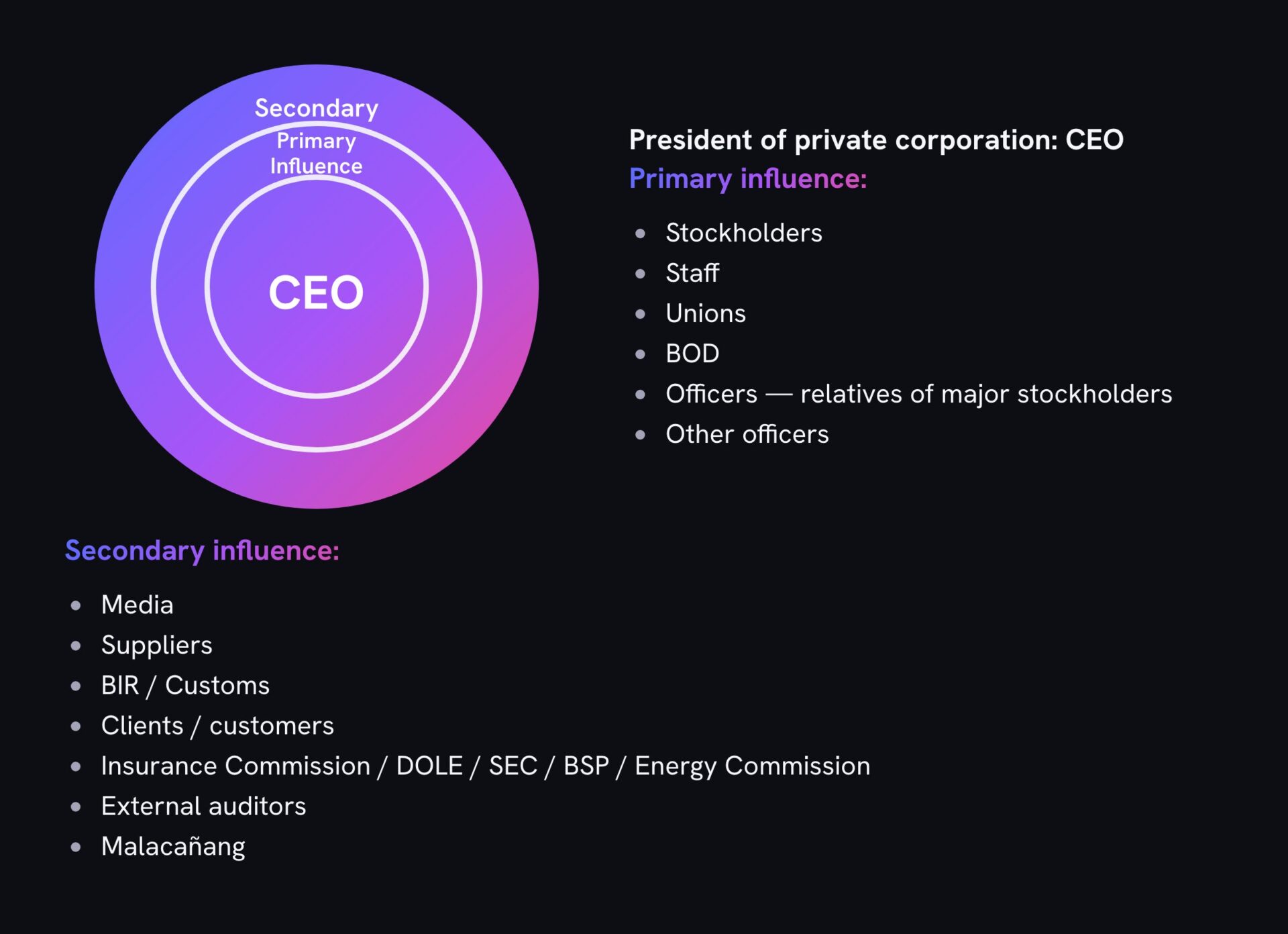
Managing your Boss
If you own the business, you may think this section is not for you. It is. Swap “boss” for whoever you have to keep on side — a board, a family patriarch, a bank, your largest investor — and the whole thing applies. John Gabarro and John P. Kotter made the argument in Managing Your Boss: the relationship runs both ways. You need that person for resources, information and a fair hearing. They need you to deliver, and to tell them the truth about what is happening further down. Calling it mutual dependence is not flattery. It is a description of who can hurt whom.
What Mutual Dependence Requires
Two things, and the first is the harder one. You need an honest read on the other person and on yourself — strengths, weaknesses, working styles, and what each of you actually needs. Then you use that read to build a working relationship that fits both people’s styles rather than only yours. A relationship that works is one where expectations run in both directions and where the other person’s most critical needs are being met. If you cannot name what your boss most needs from you, you do not have that relationship yet.
Managing the Relationship With Your Boss
Start on his side of the table. Most people manage upward on instinct and guesswork, which is why most people get it wrong. Four things are worth knowing properly.
- His goals and objectives — what he is actually being measured on, which is often not what he talks about most. A proposal that helps him hit his number gets approved. A proposal that is merely correct waits.
- The pressures on him — who is leaning on him, and about what. A boss who seems unreasonable this month is usually a boss absorbing something you cannot see.
- His strengths, weaknesses and blind spots — so you can bring him the work he is good at and quietly cover the part he is not. Every subordinate does this. The ones who do it deliberately do it better.
- His preferred work style — whether he wants a memo or a conversation, the summary or the detail, a decision brought to him early or brought to him finished. This is the cheapest thing on the list to learn and the one most often ignored.
Then turn the same honesty on yourself: your own strengths and weaknesses, your personal style, and one more thing people skip — your predisposition toward authority figures. Some of us default to compliance and never push back when we should. Others bristle at being directed at all and turn ordinary instructions into a contest. Both are habits carried in from somewhere else, and both cost you.
What you build out of that is a relationship that fits both sets of needs and styles. Four properties tell you whether you have one.
- Mutual expectations, stated out loud. Both of you can say what the other expects without guessing. Most bad boss relationships are not conflicts. They are two people operating on assumptions neither has ever checked.
- You keep him informed. Especially about bad news, and especially early. A boss who learns about a problem from somebody else stops trusting you, and he is right to.
- Dependability and honesty. You do what you said, on the date you said, and when you cannot, you say so before the deadline rather than after. This is unglamorous and it is most of the job.
- Selective use of his time and resources. His attention is finite. Spend it on the decisions that genuinely need him and handle the rest yourself, and the ones you do bring will get taken seriously.
International Expansion
| Mode | Characteristic | Advantages | Disadvantages |
| Exporting and licensing Examples: San Miguel Corporation; Japanese manufacturing firms in China | Producing goods in one country and selling the same to local distributors in another country. The exporter has no control over the other product lines of the importer, unless the licensor wants and is able to enforce some kind of exclusivity clause in the license agreement. Local distributors normally invest in training, information systems, advertising and promotion. There is a choice between direct selling and using indirect channels through distributor partners; direct selling becomes an option where there is a relative lack of distribution and communications infrastructure, and low-cost sales personnel are available. | Avoids manufacturing cost in the recipient country. Gains more experience about the new market. | Cost differentials, since there are lower-cost locations for manufacturing. High transport cost. Divided loyalties of partners, who carry competing products. Issues. Local distributors demand territorial exclusivity, though multiple partners are more appropriate for rapid market expansion. MNCs unfamiliar with the local marketing environment grant partners significant control over marketing decisions, such as pricing structures or promotional strategies. |
| Franchising Examples: US franchisor in the Persian Gulf and Asia | A contractual agreement in which a company receives a royalty or fee in exchange for the right to use its intellectual property. The franchisor receives franchise fees. Common in restaurant and retail trade areas. | Limits risk exposure in the overseas market while extending and expanding the parent company’s market. Limited investment needed. | |
| Strategic alliances Examples: Microsoft with IBM/Mac; Fujitsu with FedEx; 3M with Squibb | Forming alliances to enter new markets, or to develop and diffuse new technologies rapidly. Creation of a third-party legal entity is not necessary. | Strategies can be implemented quickly. Reduces costs through alliances with suppliers or customers. Brings expertise, lower costs and new products. | |
| Joint venture Examples: Jollibee with Lao Dong Resto; Bristol-Myers with Squibb | A third party is created as a legal entity. Case point: Russia. Three obstacles were currency convertibility, supply shortages, and a shifting regulatory and legal environment. The solution was to put local managers in charge and delegate authority. | Mitigates some of the barriers associated with marketing products and services in a foreign country. | Entry barriers. Language. National culture. Laws and regulations. Resistance to foreigners and their products or services. Foreign exchange considerations. |
| Wholly-owned subsidiaries Examples: J&J; Komatsu; Hitachi Ltd; Jollibee; 3M; Honda | Owns 100% of the stock of the business entity, either through acquisition of an existing company or through development of a totally new operation, known as a greenfield venture. Other MNCs establish only marketing firms in a foreign country. | Control over sourcing and marketing. Allows managers to expand as quickly as they want and where they want, without the burden of an uncooperative partner. |
Conducting R&D in Foreign Countries
Expanding abroad let companies put research next to the places where knowledge is actually being made, and get new products to market faster because of it. It also changed the job of the people running that research. You stop managing people and processes and start managing knowledge — holding a global network together by setting the research agenda, monitoring what comes out of each site, and making sure the sites are talking to each other instead of quietly duplicating one another’s work.
Three strategic objectives account for most decisions to keep a research facility in another country.
- To be near foreign universities — the research gets published eventually, but the people who did it are hired long before that. Proximity buys you the graduates and the informal conversations, not just the papers.
- To be near competitors — which sounds backwards until you notice that industries cluster for a reason. Sitting where your rivals sit means you learn what they are doing at the speed the market does, rather than reading about it a year later.
- To be where products move quickly from development to commercial stage — some places have the suppliers, the regulators and the early customers lined up so that a working prototype becomes a sellable product in months. Others do not, and no amount of research budget fixes that.
The pattern behind all three is the same. Establish a presence in several locations, so that new knowledge from foreign universities and competitors gets absorbed into your own organization rather than admired from a distance. Then move on it, because the advantage only holds if you get from development to market faster than the people you learned it from.
Those sites come in two kinds, and it is worth being clear which one you are opening. A home-base-augmenting site exists to gather new knowledge and feed it back to the company. A home-base-exploiting site exists to take what the company already knows and put it to work locally, manufacturing and marketing products adapted to what that market actually wants. One brings knowledge in. The other takes knowledge out. Staffing them the same way is a common and expensive mistake.
Building Foreign Plants and Factories: The Strategic Roles
Which expansion mode you pick follows from what you are trying to achieve, and it has to suit the market you are entering. The table above is not a menu of equally good options — it is five different answers to five different questions. Before committing to any of them, study the host country properly: economic conditions, culture, the legal and regulatory environment, and whatever else is particular to that market. These are not background reading. They decide whether the operation works.
A foreign plant is also no longer just a place where things get made. Factories have grown into centers of product innovation and into supply points for entire regional markets. That is why some multinationals now put less weight on low wages when choosing a site than they used to: manufacturing and product development have both become more sophisticated, and having world-class suppliers nearby matters more than shaving a few pesos off the labor line. Cheap is a weak reason to be somewhere. Capable is a durable one.
The simplest of these roles is the offshore or source factory, which exists to produce at low cost. Three conditions have to hold together for it to work, and any one of them on its own is a trap.
- Production costs are genuinely low — low across the whole landed cost, not just the wage line. Freight, duties, spoilage and rework have undone more offshoring decisions than wages ever justified.
- Skilled workers are available — in the numbers you need, not in principle. A low wage rate in a place where you cannot actually hire fifty trained operators is a wage rate you will never get to pay.
- The infrastructure is developed enough — power, ports, roads, telecoms. Philippine manufacturers know this one from the inside: the cost of a site is whatever the site costs, plus the cost of everything that does not work there.
Server or Contributor Factory
A step up from the offshore factory. This one is built to serve a market rather than only to make things cheaply, and it carries more of the company’s capability with it.
- It supplies a national or regional market — producing near the customers who buy the product, which cuts freight, cuts lead time, and puts you inside whatever trade barriers apply.
- Its scope includes product and process engineering — and this is the real difference. The site is not simply following instructions from head office. It can change the product and improve how the product is made. That is what makes it a contributor rather than a server.
- Low wages are still part of the case — but they are no longer the whole of it, which is exactly what makes this kind of plant harder to walk away from the moment somewhere cheaper appears.
Lead factory
The most advanced of the three. A lead factory creates new processes, products and technologies for the entire company, not just for its own market, and innovation starts there rather than arriving from headquarters. The site has stopped being an outpost and become a source. Few companies get here, and the ones that do usually did not plan it — a contributor factory kept solving its own problems well enough that the rest of the group started copying it.
Tangible Reasons
Whichever kind of plant you are building, the reasons for choosing one country over another divide into two sorts. The tangible ones are the four you can put in a spreadsheet.
- Cheap labor — the reason everyone starts with, and the one that erodes fastest, because wages rise in exactly the places that succeed at attracting factories.
- Reduced logistics costs — being close to your customers, or close to your suppliers. A quieter argument than wages and usually a more durable one.
- Tariff and trade concessions and other incentives — duty-free zones, tax holidays, investment incentives. Read the expiry dates. Incentives are granted for a period, and the business still has to work after that period ends.
- Skilled and talented employees — not the cheapest people, the right people. This one increasingly outranks the first item on the list.
Intangible Reasons
The intangible reason is learning — from foreign research centers, from customers, and from suppliers. It never appears on the site-selection spreadsheet, and it is often what the decision turns out to have been about. When 3M chose Bangalore, the draw was the suppliers, the sophisticated competitors and the skilled workforce already there, none of which anybody could total in a column. If you take one thing from this section, take that. You go somewhere to become better at what you do. Cost is only the entry ticket.
A closing note for owners. Most of the tools on this page were built for corporations with planning departments. The judgment underneath them is the same one a Philippine business owner makes alone: where to compete, what to stop doing, and which advantage is actually defensible. If you want a second set of eyes on your own strategy, that is the work I do in my consulting practice.


